Seeds and Your Gut: Why a Spoonful of Flax Goes Further Than You’d Think
Flaxseed, sesame and chia are simple everyday additions that can bring meaningful fibre and variety to your diet without turning seeds into another health task.
Table of Contents
Flaxseed carries about 26.17g of fibre per 100g (IFCT 2017). That’s more than double the fibre of whole wheat atta, more than most dals, and more than any other everyday Indian food this series has covered. A single teaspoon of flaxseed — about 5g — adds roughly 1.3g of fibre to whatever it’s stirred into. Seeds are the most fibre-dense everyday addition most Indian kitchens already have, and the most consistently underestimated one.
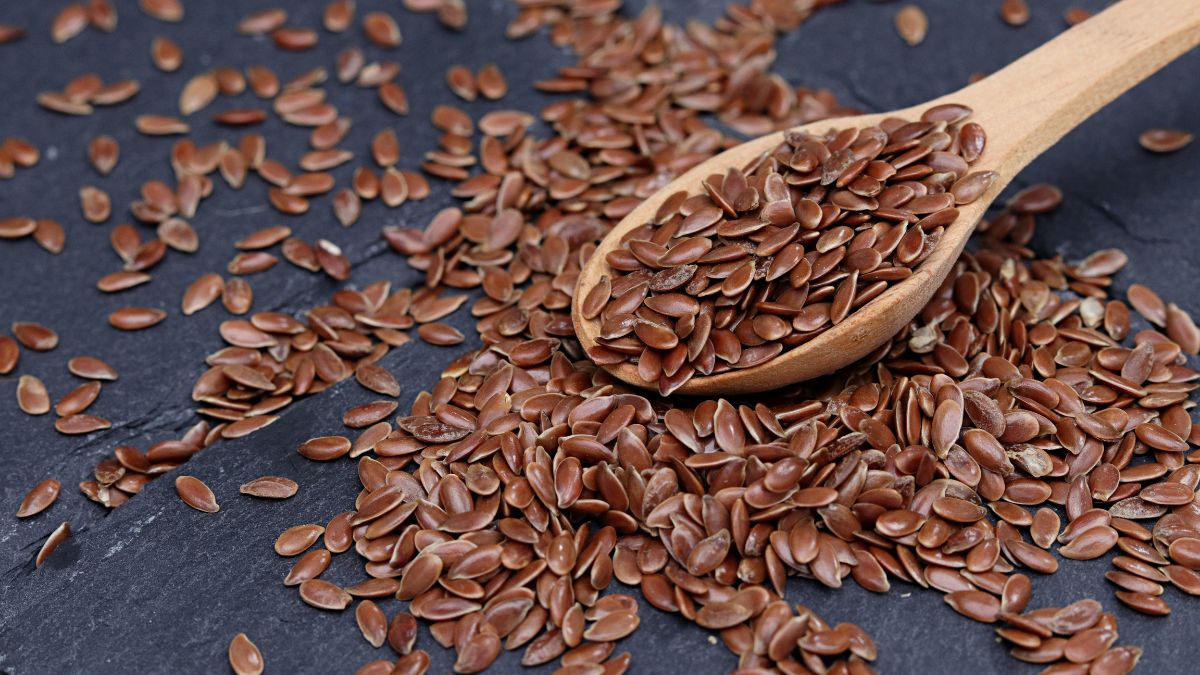
Flaxseed (alsi) at about 26.17g of fibre per 100g sits at the top of this series’ verified fibre data — ahead of chana (25.22g), ahead of millets, ahead of whole wheat atta. It’s also a good source of omega-3 fatty acids (ALA, the plant form) and lignans. The fibre is partly soluble — which contributes to the gel-forming properties flaxseed is known for in water — and partly insoluble. Both types contribute to gut health in different ways: the soluble fibre slows digestion and feeds gut bacteria; the insoluble adds bulk.
| ⓘ Seeds Fibre at a Glance Flaxseed (alsi): ~26.17g fibre per 100g — highest verified figure in this series’ entire dataset Sesame (til): ~17g per 100g — approximate; comparable to whole moong Chia seeds: well-regarded for soluble fibre content, but no IFCT figure in current briefing A single teaspoon of flaxseed (~5g) adds ~1.3g fibre — disproportionate to its volume. All three are naturally gluten-free |
Sesame (til) is already deeply embedded in Indian cooking — in tilgul (Maharashtra), til ladoo, chikki, in chutneys and as a garnish across regions. Its fibre content is roughly 17g per 100g — in a similar range to whole moong dal, and considerably more than most grains. The same logic as flaxseed applies: a small spoonful of sesame, added to a dal, stirred into curd, or used in a chutney, adds meaningful fibre to a meal in very little volume. The fact that it’s already in most Indian kitchens makes it one of the lowest-friction fibre additions available.
Chia seeds have earned a significant reputation for their soluble fibre content and water-absorption properties — when soaked, they form a distinctive gel from the mucilaginous soluble fibre they contain. This is real and genuinely useful for gut health and for satiety. However, no specific IFCT 2017 figure for chia seeds exists in this series’ current verified briefing (chia is not a traditional Indian crop), so this piece describes chia’s properties directionally rather than quoting a specific number. What can be said accurately: chia is a good source of soluble fibre, works well soaked in water or added to yoghurt or smoothies, and has a genuine gut-health reputation that isn’t primarily marketing-invented.
The most useful thing about seeds from a practical standpoint is that they don’t require a recipe change — they’re additions, not substitutions. A spoon of flaxseed stirred into curd. Sesame scattered over a sabzi or into a chutney. A tablespoon of chia soaked in water and added to a glass of nimbu paani. Roasted flaxseed or sesame mixed with jaggery as a small post-meal snack. None of these requires eating at a different time, cooking differently, or treating seeds as a health supplement rather than an ordinary kitchen ingredient.
Whole flaxseeds can pass through the digestive tract largely undigested, which means their fibre content is available, but some other nutrients — omega-3s, lignans — are less bioavailable than from ground flaxseed. Grinding flaxseed before eating, or buying pre-ground (flaxseed powder), ensures the full nutritional content is accessible. The fibre contribution is roughly equivalent from both forms; the omega-3 and lignan benefit is better from ground. A small coffee grinder or spice grinder, used for a week’s worth at a time and stored in the fridge, is the most practical approach for most kitchens.
Flaxseed is the fibre standout in this group by a meaningful margin, but eating the same seed daily in isolation misses the point of the broader variety argument this series makes consistently. Flax, sesame and occasional chia each bring different fatty acid profiles, different phytochemicals and different preparations — rotating across two or three is more nutritionally diverse than maximising one. The goal isn’t flax every day; it’s a few different seeds showing up across a week in whatever amounts fit naturally into the meals you’re already eating.
Most Indian households encounter sesame in its roasted form — as til in ladoo, chikki, or dry-roasted as a snack. Roasting changes flavour significantly but doesn’t dramatically alter fibre content. Flaxseed is most commonly eaten raw or lightly roasted, and is more commonly ground than eaten whole (for bioavailability reasons covered above). The main practical consideration is storage: whole flaxseeds and sesame both have an oil content that makes them go rancid faster than grains; keeping seeds in an airtight container away from heat and light extends their shelf life.
Fibre supplements (isabgol/psyllium, in particular, which has the strongest evidence for constipation specifically) are a different category from food-based seeds, and this piece isn’t interchangeable with advice about supplementation. Eating flaxseed and sesame as part of varied meals is a genuinely good dietary habit; it’s not a substitute for a supplement that provides a concentrated dose of a specific fibre type if that’s what a specific clinical situation calls for. The gut-health series piece that covers the supplement question is the piece, Why More Fibre Can Sometimes Make You Feel Bloated.
Disclaimer: This article is for general informational purposes only — not medical or dietary advice.
Flaxseed carries about 26.17g of fibre per 100g (IFCT 2017) — the highest verified figure in this series, ahead of chana dal and all the grains covered elsewhere.
This series doesn't give a specific daily target. A teaspoon (about 5g) adds roughly 1.3g of fibre — a meaningful addition to whatever it's stirred into, without a large volume.
Ground flaxseed makes more nutrients bioavailable, including omega-3s and lignans. The fibre contribution is broadly similar from both forms. Ground is generally the better choice.
Yes — sesame carries roughly 17g of fibre per 100g, comparable to whole moong dal. It's also already deeply embedded in Indian cooking, making it one of the lowest-friction fibre additions available.
Yes, chia has a strong reputation for soluble fibre content. This series doesn't quote a specific figure since no IFCT 2017 number is in current verified briefing, but the fibre reputation is not primarily marketing-invented.
No — flaxseed and sesame are available in most Indian grocery stores and already present in many Indian kitchens. Chia is more of a specialty product; the same gut-health case can be made with Indian seeds alone.