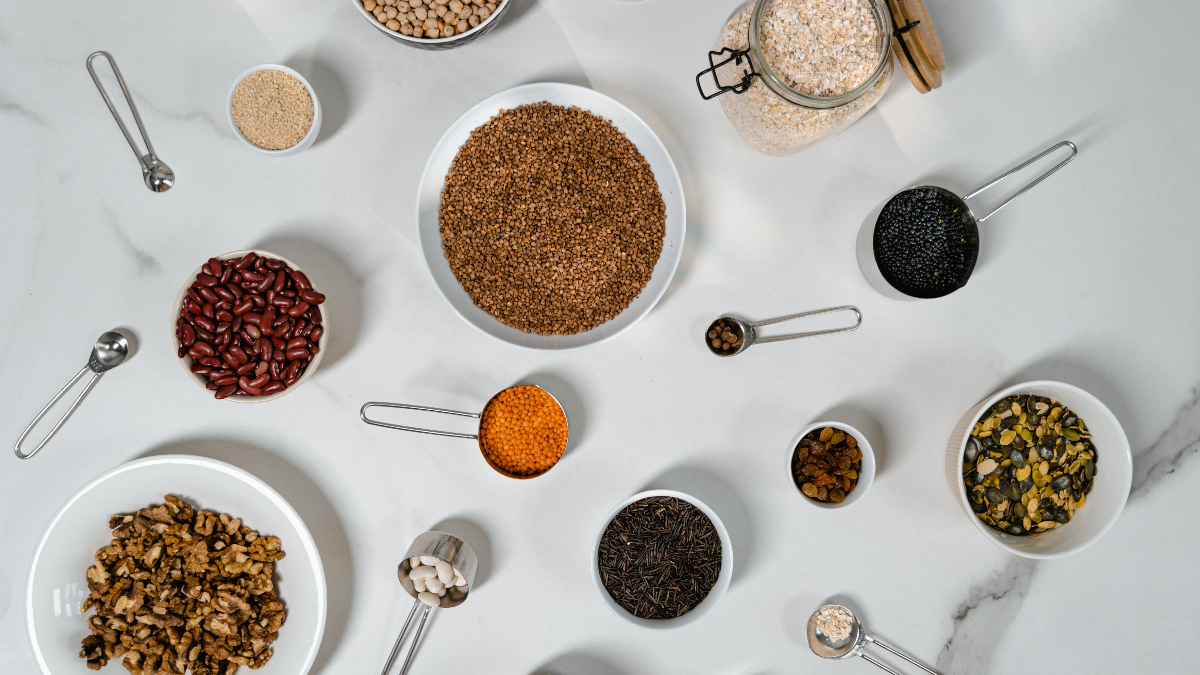
What 40g of Fibre Looks Like in a Day of Indian Meals
40 gm sounds like a project. Here is the arithmetic on an ordinary Indian day — with the assumptions shown, so you can check my working.
Table of Contents
A day built around whole-grain rotis, dal, rajma, guava, roasted chana, rice and vegetables can provide approximately 40g of dietary fibre or more, depending on the portions.
In the example below, five rotis made from 150g of whole-grain flour provide about 17.1g fibre. A 100g serving of guava adds approximately 8.6g, while dals, pulses, rice and vegetables contribute the rest.
The illustrated day adds up to approximately 42.6g before vegetables, or 50.4g including the two vegetable preparations calculated from raw ingredients.
This is an example, not a daily menu to follow or a requirement to reach 40g. ICMR-NIN’s fibre reference values vary by sex and physical activity, and an individual’s needs may differ.
Read this if: you have seen the 40g figure and cannot picture what it means in food; or you want to know roughly where you already stand without weighing anything.
One thing to say at the outset: this is an illustration, not a prescription, and certainly not an instruction to weigh your food or count fibre daily.
Do this arithmetic once, get a feel for where your day sits, and then stop counting.
If tracking food is something you find difficult or preoccupying, read the shape of the day below and skip the numbers entirely — they are not the useful part.
No, and this is worth clearing up before we do the sum.
The ICMR-NIN 2020 recommendations give different daily dietary fibre reference values according to sex and activity level.
For sedentary adults, the figures are 30g for men and 25g for women. For moderately active adults, they rise to 40g and 30g respectively. For those doing heavy physical work, the figures are higher still.
The World Health Organization recommends at least 25g of naturally occurring dietary fibre a day for adults.
So 40g is a useful number to demonstrate, not a threshold every Indian adult must reach.
In my experience, though, the figure lands badly whenever people encounter it. It sounds like something requiring a special diet, and people assume they are nowhere near it.
So let me do the sum properly, on a day built entirely from familiar Indian foods, and show every assumption I am making.
If you disagree with an assumption, you can adjust it — which is rather the point of showing the working.
| When | What | Amount used for calculation | Approx. fibre |
|---|---|---|---|
| Breakfast | 2 rotis, made with Aashirvaad Chakki 100% Khapli Atta | 60g flour | 6.8g |
| Mid-morning | 1 whole white-fleshed guava | 100g edible portion | 8.6g |
| Lunch | 3 rotis, made with the same whole-grain atta | 90g flour | 10.3g |
| Lunch | Toor dal, 1 katori | 25g dry dal | 2.3g |
| Lunch | Bhindi sabzi | Made from 100g raw bhindi | 4.1g |
| Evening | A small fistful of roasted chana | Estimated using 25g dry whole Bengal gram before roasting | 6.3g |
| Dinner | White rice | 60g raw rice | 1.7g |
| Dinner | Rajma, 1 katori | 40g dry red rajma | 6.6g |
| Dinner | Cauliflower sabzi | Made from 100g raw cauliflower | 3.7g |
| Subtotal excluding the two vegetables | 42.6g | ||
| Estimated full-day total | 50.4g |
Values are rounded to one decimal place. Most figures use the Indian Food Composition Tables 2017; the Khapli value uses the reported product-specific nutrition figure of 11.4g dietary fibre per 100g. Vegetable values apply to the stated raw ingredients before cooking. The roasted-chana calculation uses dry whole Bengal gram as an approximation, not a laboratory measurement of a particular packaged snack.
That’s about 42.6g before counting the bhindi and cauliflower, and just over 50g when we include both.
Nobody in this illustration ate anything imported or bought a special fibre supplement.
But I want to emphasise the word illustration.
Five rotis, two pulse preparations, a serving of rice, fruit and a pulse-based snack will not describe every household’s ordinary day. Nor should everyone attempt to reproduce it.
The point is not that this is the amount you ought to eat.
It is to show how much fibre familiar ingredients can contribute, and how quickly those contributions add up.
Roti size: 30g of flour per roti. Rotis vary considerably between households. A smaller roti contributes less fibre; a larger one contributes more.
Dal portions: A cooked katori of dal or rajma is assumed here to have been prepared from 25g or 40g of dry pulses respectively. Those amounts are assumptions, not universal katori measurements.
This is the single most common place a fibre calculation goes wrong, because composition tables give figures per 100g of the dry food, and 100g of dry dal makes far more than one katori.
Vegetables: Poulomi’s additions allow us to count the bhindi and cauliflower, using IFCT values of 4.08g and 3.71g total fibre per 100g of the raw edible ingredients respectively.
That adds approximately 7.8g to the day.
It does not mean that 100g of cooked bhindi or cauliflower will have exactly the same fibre content per 100g of cooked weight. Cooking changes water content, and the amount of raw vegetable used is the basis of this calculation.
Roasted chana: The 6.3g estimate uses the dry whole Bengal gram reference value. Actual roasted-chana products can differ in moisture content, preparation and composition. Treat it as an approximation.
Guava: The figure of 8.59g per 100g is for white-fleshed guava in IFCT 2017. The fibre content of other varieties and actual edible portions can differ.
Fibre figures: The calculations use whole-grain Khapli atta at 11.4g per 100g as reported in the relevant product documentation, with regular whole-wheat atta at 11.36g in IFCT 2017.
The two flours are effectively level on total fibre in these figures.
These distinctions may seem fussy.
They are also what separates a useful calculation from an impressive-looking number that nobody can reproduce.
Three things fall out of that table that are worth more than the total itself.
Five rotis across the day contribute about 17g of fibre, simply because there are five of them.
This is why the whole-versus-refined decision on flour can make such a difference in a household that eats rotis regularly.
Using Aashirvaad Chakki 100% Khapli Atta at its reported 11.4g fibre per 100g, five rotis made from 150g flour contribute approximately 17.1g.
Using ordinary whole-wheat atta at 11.36g per 100g gives practically the same result.
The same 150g of refined maida, listed at 2.76g fibre per 100g in IFCT, contributes only about 4.1g.
That is a meaningful difference, and one that repeats in households where roti is a staple.
It isn’t an argument that Khapli is higher in fibre than ordinary whole-wheat atta. The figures do not support that.
It is an argument for what retaining the whole grain can contribute.
A small portion of whole Bengal gram can contribute substantial fibre.
In this calculation, the equivalent of 25g dry whole chana contributes approximately 6.3g — more than the assumed katori of toor dal, and much more than the rice at dinner.
That is worth noticing.
Some of the most fibre-rich foods in the Indian kitchen already live on the dal shelf, and several of them make excellent snacks.
The exact fibre content of a ready-to-eat roasted-chana snack may differ from the dry-grain estimate, but the larger point holds.
In this example, 100g of white-fleshed guava contributes approximately 8.6g fibre, making it one of the day’s largest individual sources.
Whole, not strained into juice.
When a fruit is juiced and its pulp or other fibre-rich parts are discarded, much of its fibre can be lost.
The whole fruit brings something that juice generally does not retain in the same amount.
And it requires no unusual food, no new recipe, and no great deal of effort.
It is equally instructive to see how quickly the same day loses its fibre.
Change three things and watch what happens.
Here’s the arithmetic, with the same caution about assumptions.
| Version of the day | Approximate fibre |
|---|---|
| Original foods, before counting vegetables | 42.6g |
| Same foods, including both vegetable preparations | 50.4g |
| After the three swaps, excluding vegetables and any fibre in the replacement juice or biscuits | 14.7g |
| After the three swaps, retaining both vegetable preparations, but excluding any fibre in the replacement juice or biscuits | 22.5g |
The replacement juice and biscuits aren’t automatically fibre-free. Their actual fibre content would need to be added from their labels or recipe ingredients.
Still, look at the size of the change.
The same broad day has lost almost 28g of fibre from three decisions about the form of foods that were already present.
No extra meal was needed to make the difference, and no imported ingredient was involved.
That is the useful lesson here, and it is the reverse of the one people expect.
Sometimes the shortfall is not simply about how often you eat.
It is about which version of the same food you chose.
I am wary of arithmetic like this becoming a daily habit, so let me be clear about how I would actually use it.
Do it once.
Sit down with a typical day of yours, apply the same method, and find out roughly where you land. That gives you a sense of whether you may need more fibre-rich foods in your routine.
Then put the calculator away.
After that, the useful version is structural rather than numerical.
Ask yourself four questions:
Four questions, no weighing.
These questions won’t calculate your exact intake or guarantee that you have met a particular target.
But they will give you a more useful picture of your eating habits than monitoring every gram.
For a practical guide to making those changes, read How to Increase Fibre in an Indian Diet.
And for a closer look at what different fibre types contribute, see Soluble vs Insoluble Fibre in Everyday Indian Foods.
Two things are worth remembering before anyone treats 40g as a number to hit precisely.
First, if you are currently eating much less fibre, do not try to close the gap in a weekend. Increase gradually and maintain adequate fluid intake, unless your doctor has advised otherwise. Sudden large increases can cause bloating, gas and abdominal discomfort.
Second, more is not automatically better. For some digestive conditions, less fibre or a different type of fibre may be the correct advice.
And 40g isn’t everyone’s individual requirement in the first place.
That is why the calculations in this article are intended to explain food, not prescribe a diet.
Source: British Dietetic Association, Fibre Food Fact Sheet.
Forty grams need not be a project.
The ordinary Indian kitchen already contains the ingredients that can help build a fibre-rich day: whole grains, pulses, vegetables, fruits, nuts and seeds.
The useful part is recognising what they contribute, and then getting on with eating.
“Using my usual Indian meals and rough portions, estimate where my fibre comes from. Show me the assumptions and suggest a few practical changes, but don’t give me a rigid daily target or ask me to track every gram.”
This article is intended for general educational and informational purposes and does not constitute medical advice or a personalised diet plan.
The fibre quantities are illustrative estimates based on assumed ingredient weights and published reference data. Actual values may vary according to grain variety, product formulation, food preparation, serving size and cooking methods.
Daily fibre needs vary by age, sex, physical activity, energy requirements and health status. A 40g intake is not a universal requirement, and the sample menu is not a prescribed meal plan.
Increase fibre gradually and maintain adequate fluid intake unless you have been medically advised otherwise. People following low-fibre, low-FODMAP or other therapeutic diets, or experiencing persistent gastrointestinal symptoms, should follow their doctor’s or qualified dietitian’s advice.
If monitoring food quantities causes anxiety, distress or compulsive tracking, avoid numerical monitoring and seek individual professional guidance where appropriate.
Poulomi Mukherjee, M.Sc. Food and Nutrition
Poulomi Mukherjee holds a Master’s degree in Food and Nutrition. She works in nutrition education and writes for Happy Tummy on gut health, fibre and the evidence behind everyday food choices.
A roti made from 30g of whole-grain flour containing around 11.4g dietary fibre per 100g provides approximately 3.4g fibre. The actual amount depends on the size of the roti and the flour used. Aashirvaad Chakki 100% Khapli Atta and regular whole-wheat atta have almost identical total-fibre values in the figures compared here.
It is possible to reach 40g through ordinary Indian foods. The illustrated day reaches approximately 42.6g before counting vegetables, and around 50.4g with the stated raw vegetable quantities included. But this is a substantial high-fibre example, not a recommendation to eat those exact amounts. Many adults have appropriate reference intakes below 40g.
ICMR-NIN's 2020 figures vary by sex and activity level. For sedentary adults, the references are 30g daily for men and 25g for women. For moderate activity, they are 40g and 30g respectively; for heavy activity, 50g and 40g. Individual medical and dietary needs may differ.
There is no fixed amount. In this illustration, a katori of toor dal is assumed to have been prepared from 25g dry dal, and the rajma serving from 40g dry beans. Water added during cooking changes the final weight and consistency. You cannot treat 100g of cooked dal as though it contains 100g of dry dal.
IFCT 2017 lists whole Bengal gram at approximately 25.22g dietary fibre per 100g of the dry grain. That makes the contribution from 25g of the dry grain about 6.3g. However, a particular roasted-chana product may have a different per-100g value, so check its label when you need a more accurate estimate.
Some varieties are particularly fibre-rich. The white-fleshed guava entry in IFCT 2017 lists 8.59g dietary fibre per 100g edible portion. Other varieties and serving sizes may differ. Eating the whole fruit generally retains more fibre than drinking juice from which pulp has been removed.
Yes. IFCT 2017 lists 11.36g fibre per 100g of whole-wheat atta and 2.76g per 100g of maida. In this comparison, refining removes roughly three-quarters of the fibre present in the whole-grain flour.
It depends on the foods and amounts eaten. In the worked example, five rotis contribute the largest combined amount because they use 150g of flour. Guava, whole chana, rajma and vegetables also make meaningful contributions. No single food needs to supply the whole day's fibre.
Yes. The five rotis are an assumption used for the example, not a recommendation. Whole pulses, vegetables, fruits, other whole grains, nuts and seeds can all contribute fibre. The amounts and combinations should suit your appetite, energy requirements and overall nutritional needs.
Not necessarily. One rough calculation may help you understand where fibre comes from, but routine weighing or tracking isn't required for most people. A more practical approach is to include a range of fibre-rich foods consistently. If food tracking causes anxiety or preoccupation, skip the calculations and focus on manageable eating habits instead.