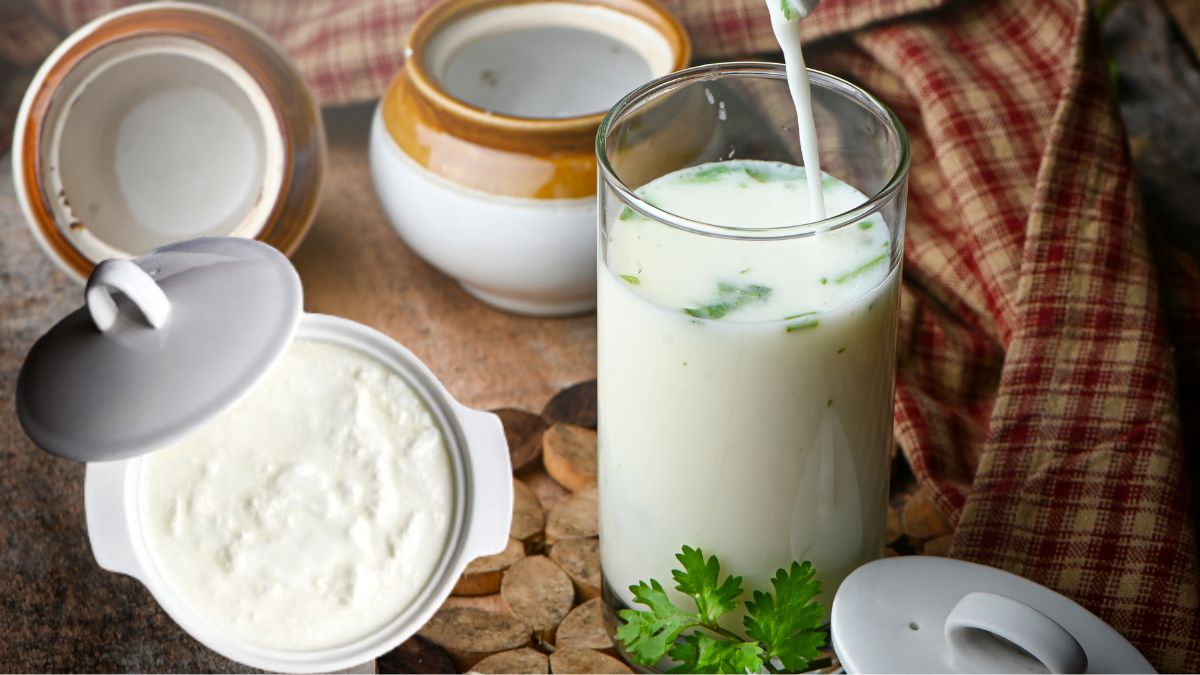
Curd, Buttermilk and Your Gut: India’s Everyday Probiotics
Curd and chaas bring live cultures to everyday Indian meals. Here’s what fermentation actually does, what the evidence supports, and where probiotic claims go too far.
Table of Contents
Curd (dahi) and its sibling chaas (buttermilk) have been part of Indian eating for millennia, and the modern language of ‘probiotics’ and ‘gut microbiome’ is, in many ways, just a scientific framework for something Indian cooking has always known: fermented dairy sits well in the gut, and a meal that includes curd tends to feel more settled than one that doesn’t. This piece is the explanation of why — and where the honest limits of that claim are.
Curd is made by adding a live culture starter — typically Lactobacillus bulgaricus and Streptococcus thermophilus, or similar lactic acid bacteria — to warm milk and allowing it to ferment. The fermentation produces lactic acid (which gives curd its characteristic tang and thickens the milk), and leaves behind live bacteria in the finished product. These live cultures are what makes curd a probiotic food: they’re live microorganisms that, when eaten in adequate amounts, may contribute to gut microbiome diversity.
It’s worth being precise about what the probiotic claim does and doesn’t mean for everyday dahi. The formal WHO definition of a probiotic requires live microorganisms to be present in adequate amounts and to confer a proven health benefit. Home-set curd, where cultures are passed from batch to batch, contains live bacteria, but the strain composition and count varies. Commercial curd and yoghurt vary by product. ‘Probiotic’ as it applies to ordinary Indian curd is best understood as ‘contains live cultures from fermentation’ rather than as the clinically standardised health claim attached to specific probiotic supplements or products. Both are useful; they’re not the same thing.
| ⓘ Curd as a Probiotic Food: What’s Accurate Contains live lactic acid bacteria from fermentation — genuinely a probiotic food in this sense Specific strain composition varies by batch, source and method — not standardised like a supplement May contribute to gut microbiome diversity as part of a varied diet — directionally supported Not a cure for specific digestive conditions — this series doesn’t make that claim The traditional Indian intuition behind curd’s digestive role is well-founded; the specific mechanisms are still an active area of research |
Chaas is what remains after churning curd to make butter — or, in most modern households, curd diluted with water and seasoned with salt, jeera and sometimes ginger or mint. It carries the same live cultures as the curd it comes from, in a more dilute form. Traditionally drunk after meals in North India specifically, chaas has a long association with cooling the body, easing post-meal heaviness and supporting digestion — associations that are culturally embedded rather than clinically measured, but not implausible given its fermented character and relatively easy digestibility compared to whole curd.
This is worth addressing directly, because it’s a common source of confusion. Curd is generally better tolerated by people with lactose intolerance than plain milk, for a specific reason: the lactic acid bacteria in fermented curd partially digest the lactose during fermentation, reducing the amount present in the finished product. Many people who can’t drink milk without discomfort can eat curd without the same issue. This isn’t a universal rule — tolerance varies by person and by how much lactose remains after fermentation — but it’s a genuine property of the fermentation process, not a myth.
There’s no required daily amount of curd for gut health, and this series doesn’t set one. What can be said is that regular inclusion — as part of a meal, alongside a grain and vegetable, as the base of raita, or as a post-meal chaas — is consistent with the traditional role fermented dairy plays in Indian eating patterns, and consistent with what the current understanding of gut microbiome diversity suggests about varied fermented food intake. The goal isn’t to eat curd every day as a health task; it’s to let it sit naturally in meals where it already belongs.
Curd is not a cure for irritable bowel syndrome, acidity, bloating, constipation or any other specific digestive condition. These claims circulate widely, and this series won’t amplify them. Curd is a traditional, fermented food with live cultures that contributes to a varied diet in a way a non-fermented dairy food wouldn’t — that’s a genuine, meaningful contribution, and it doesn’t need to be inflated beyond it to justify curd’s place at the Indian table.
The most durable nutrition advice is usually the kind that simply makes what’s already good clearer, rather than adding something new. Curd and chaas are already in most Indian kitchens and already part of most Indian meals in one form or another. Knowing why they’re there — not just culturally but in terms of what fermentation actually does — is enough to make their use more intentional without any extra effort. No new products, no supplementation, no overhaul: just a better understanding of what the dahi in the fridge is already doing.
One practical note: live cultures in curd gradually reduce as curd ages in the refrigerator. Fresher curd, set more recently, is likely to contain more active live bacteria than curd that’s been sitting for several days. This doesn’t mean old curd is harmful — it’s still fine to eat — but it does mean that the live-culture benefit is strongest from fresh, recently set dahi rather than from curd kept in the back of the fridge for a week. The traditional habit of setting fresh curd every couple of days, rather than keeping one pot going indefinitely, turns out to have a genuinely sensible basis.
The most natural setting for curd in an Indian meal is already designed around balance: raita pairs with a spicier main, curd rice is a classic cooling close to a meal, chaas cuts through an oilier preparation. None of this was designed as a probiotic intervention — it emerged over centuries as a culinary and sensory logic. The good news is that the gut-health rationale and the culinary rationale align, which is the most sustainable kind of nutrition advice: eat the thing that already makes the meal taste and feel right, and the rest tends to follow.
Disclaimer: This article is for general informational purposes only — not medical or dietary advice.
Yes, in the sense that it contains live lactic acid bacteria from fermentation. It's not a standardised clinical probiotic supplement, but it's a genuine source of live cultures when fresh.
Curd is a fermented food with live cultures that contributes to a varied diet, and traditional culinary logic has placed it in meals specifically where it aids comfort. This series describes it as a genuinely beneficial inclusion rather than a proven digestive medicine.
Often yes — fermentation partially digests the lactose, making curd better tolerated than milk for many lactose-intolerant people. Tolerance varies individually.
Chaas carries the same live cultures in a more dilute form. Its traditional post-meal digestive role is well-established in Indian cooking, and it's generally easier to consume in larger amounts than whole curd.
For most people, fresh curd is well-tolerated. In people sensitive to dairy fermentation or with specific conditions, individual responses can vary — but curd is not commonly a cause of gas or acidity in a generally healthy gut.
This series doesn't give a specific daily amount. Regular inclusion as part of meals — as raita, curd rice, or chaas — is consistent with traditional patterns and the broader understanding of varied fermented food intake.