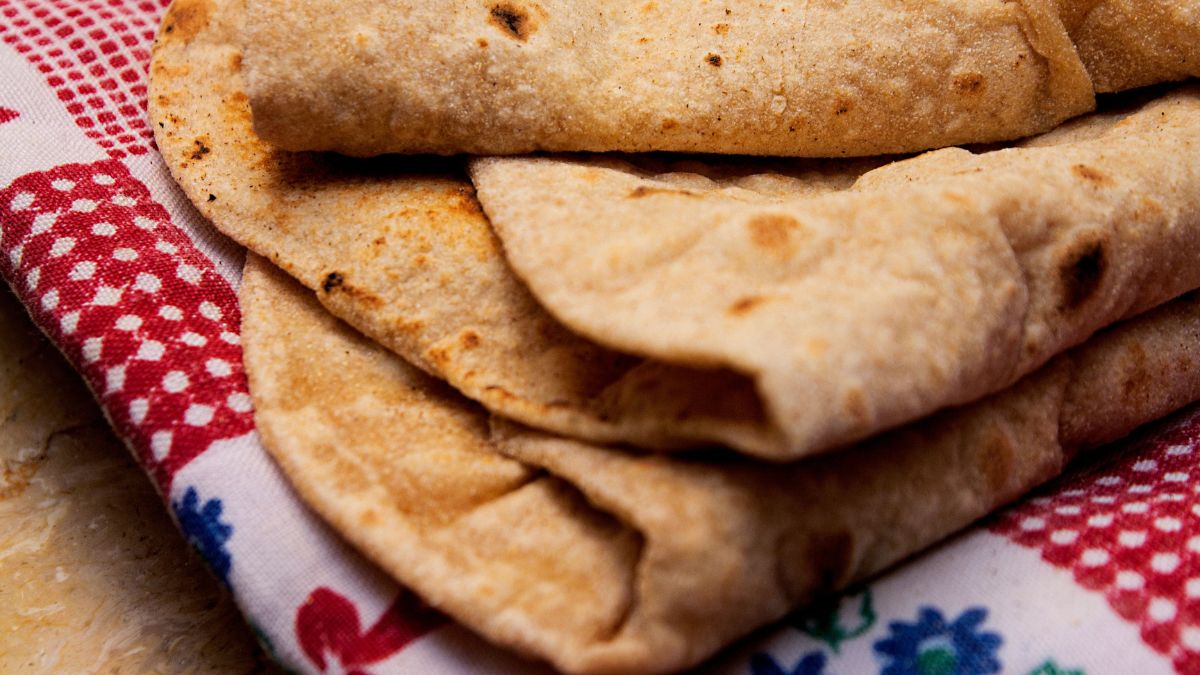
The Fibre Math of Khapli Rotis: What 2–3 Rotis Add to Your Day
Two to three Khapli rotis can contribute a meaningful share of your daily fibre target. Here’s how the numbers work and where the rest of your fibre comes from.
Table of Contents
Two to three Khapli rotis can contribute a meaningful share of your daily fibre target. Here’s how the numbers work and where the rest of your fibre comes from.
Two Khapli rotis, made from about 60g of flour, add roughly 6.8g of fibre to a meal. Three, from about 90g, add roughly 10.3g — close to a quarter of the ICMR-NIN daily fibre target of 40g, and around 41% of the WHO’s global minimum of 25g. These numbers come directly from Khapli’s verified fibre content of about 11.4g per 100g, applied to ordinary roti-sized portions. Here’s exactly how the maths works, and — just as importantly — what it does and doesn’t tell you about your day.
Khapli atta carries about 11.4g of fibre per 100g of flour. A standard roti uses roughly 30g of flour, so a single Khapli roti contributes approximately 3.4g of fibre (30g × 11.4/100). Two rotis, at 60g of flour, scale to roughly 6.8g. Three rotis, at 90g, scale to roughly 10.3g. This is straightforward proportional maths from a single verified figure — nothing here depends on rounding tricks or an optimistic assumption, just the IFCT 2017 fibre content applied to the flour actually used.
| ⓘ Quick Khapli Roti Fibre Reference 1 roti (~30g flour): ~3.4g fibre 2 rotis (~60g flour): ~6.8g fibre 3 rotis (~90g flour): ~10.3g fibre 4 rotis (~120g flour): ~13.7g fibre Based on ~11.4g fibre per 100g (IFCT 2017, brand-verified). Actual flour weight per roti varies by household; treat as a reasonable average, not an exact measure. |
Three Khapli rotis’ worth of fibre — about 10.3g — works out to roughly 25% of the ICMR-NIN daily recommendation of 40g for Indian adults, and around 41% of the WHO’s global minimum of 25g. Framed against the WHO floor, three rotis look like they’re doing most of the job. Framed against the ICMR target — the more relevant number for Indian readers — they’re doing a meaningful quarter of it. Both framings are accurate; which one feels more useful depends on which number you’re actually trying to hit.
A quarter of a day’s fibre target from roti alone is a solid start, not a finish line. The remaining three-quarters has to come from elsewhere on the plate — dal, vegetables, seeds and fruit are where an Indian thali typically closes that gap, often more efficiently than the roti does. Chana, for instance, carries about 25.22g of fibre per 100g — more than double Khapli’s figure — and a regular katori of it can do as much for a day’s fibre total as the rotis next to it. This series covers that fuller picture in The Fibre Math of an Indian Meal and Fibre Variety, Not Just More Fibre — worth reading alongside this one if the question is a whole day’s fibre, not just the roti’s share of it. It’s worth resisting the temptation to treat the roti count as the headline number of a day’s eating; on a gram-for-gram basis, the dal sitting next to it is frequently doing more, not less, of the actual work.
Yes, in a straightforward way — a larger roti made from more flour carries proportionally more fibre, and a smaller one carries less. The 30g-per-roti figure used here is a reasonable household average, not a precise measurement; thinner, larger rotis or thicker, smaller ones will shift the numbers slightly either way. The proportional logic holds regardless: fibre scales with flour weight, not with how the roti happens to be rolled.
| ⓘ Why These Numbers Don’t Change Whether You Eat Khapli or Whole Wheat Khapli (~11.4g/100g) and regular whole wheat atta (~11.36g/100g) are fibre-equivalent. This means the roti-by-roti fibre maths here is, for practical purposes, identical for a whole wheat atta roti of the same size. The Khapli-specific value in this piece isn’t a fibre advantage — it’s having the exact numbers laid out for the atta actually in your kitchen. See Whole Wheat, Khapli, Maida: The Fibre Numbers, Honestly Compared for the full three-way comparison. |
Ten-point-three grams sounds precise; in practice, it’s an estimate built on an average roti size, and real rotis vary. That doesn’t make the number useless — it makes it a reasonable planning figure rather than a measurement to chase exactly. ‘Roughly a quarter of your daily target from three rotis’ is the kind of number that’s genuinely useful for deciding what else needs to be on the plate, even though no one’s roti was actually weighed at the table.
The same proportional logic applies either way. Someone eating just one or two rotis at a lighter meal is getting roughly 3.4g or 6.8g respectively — still a meaningful contribution, just a smaller share of the day’s target. Someone eating four or five rotis at a bigger meal is scaling upward in the same proportion — roughly 13.7g at four rotis, around 17g at five. None of these numbers changes the underlying message: roti contributes a real, calculable share of a day’s fibre, and the rest of the plate still has to do real work regardless of how many rotis were on it.
This maths is specific to wheat-based rotis — Khapli or otherwise. A roti made from a millet like bajra or jowar follows a similar proportional logic but starts from a slightly different per-100g figure (bajra at about 11.49g, jowar at about 10.22g) — close enough to wheat’s numbers that switching grains doesn’t meaningfully change the fibre maths, covered in more depth in this series’ piece on millets and gut health.
This piece’s Read→Do hook isn’t about logging grams — it’s about noticing fullness, pace and comfort after a couple of Khapli rotis, because the lived experience of a meal and its fibre arithmetic are two different, equally useful things to pay attention to. A meal can be fibre-correct on paper and still feel rushed or uncomfortable if it was eaten standing up in five minutes; the numbers in this piece are most useful alongside that kind of everyday noticing, not instead of it.
Three Khapli rotis contribute a genuinely useful, verifiable quarter of a day’s ICMR fibre target — a fact worth knowing, not a number worth overstating. The rest of the day’s fibre work belongs to dal, vegetables, seeds and fruit, and the roti’s job is simply to do its share reliably, which, by the numbers, it does.
Disclaimer: This article is for general informational purposes only — not medical or dietary advice.
A single Khapli roti, made from about 30g of flour, contributes roughly 3.4g of fibre, based on Khapli's verified fibre content of about 11.4g per 100g.
About 10.3g — roughly a quarter of the ICMR-NIN daily fibre recommendation of 40g for Indian adults, and around 41% of the WHO's global minimum of 25g.
No — it's a meaningful quarter of the ICMR target, not the whole target. Dal, vegetables, seeds and fruit need to contribute the rest.
Yes — fibre scales proportionally with the amount of flour used. A larger roti carries more fibre, a smaller one less, following the same per-100g rate.
Practically no — Khapli and whole wheat atta are fibre-equivalent (about 11.4g vs 11.36g per 100g), so the roti-by-roti numbers here apply almost identically to either.
The fibre scales proportionally — four rotis add roughly 13.7g, five add around 17g, following the same per-100g rate as smaller portions.
Roughly, yes — bajra (~11.49g/100g) and jowar (~10.22g/100g) are close to Khapli and whole wheat's figures, so the per-roti maths is broadly similar across these grains.
No — these figures are useful as a general planning guide, not something to track precisely meal by meal. Noticing fullness and comfort matters just as much as the arithmetic.