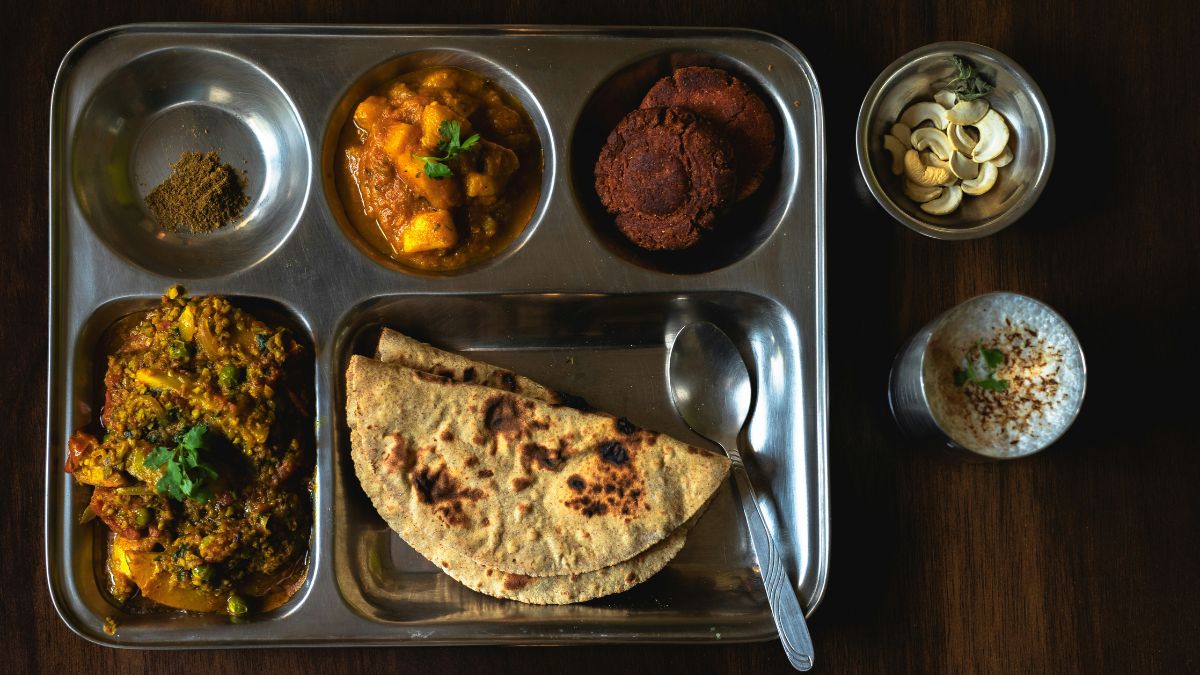
Your everyday thali already has most of what your gut needs. Here’s how a few simple changes to the dal, grain, vegetables and fermented foods on your plate can make the meal even more gut-friendly.
A gut-healthy Indian thali — one that genuinely supports your digestive system — is closer to a traditional home meal than most people realise: dal, a cooked vegetable, rice or roti from a whole grain, a bowl of fresh homemade curd, a spoonful of proper pickle or a glass of chaas. That combination, assembled by Indian kitchens long before the word “microbiome” existed, turns out to be quite a good answer to the question of what a gut-healthy diet actually looks like.
My grandmother never once used the word “probiotics.” But every single afternoon, without fail, she would set a small steel bowl of homemade curd beside her thali and quietly get on with the business of nourishing herself. There was no fuss, no supplements lined up on the counter, no wellness routine to speak of. Just a deeply intuitive relationship with food that, looking back, was brilliant.
It is only now, watching the world catch up to what Indian kitchens have known for centuries, that the full picture comes into focus. The traditional Indian thali was never just a meal. It was, in many ways, a gut-healthy diet assembled by instinct, passed down through generations, and eaten with consistency. The good news is that you do not need to reinvent anything. You just need to pay a little closer attention to what is already on your plate.
Why the Thali Was Always Ahead of Its Time
A proper Indian thali is a study in balance. There is something warm and starchy, something tangy and fermented, something fibrous and earthy, something cooling and creamy. And it turns out, from a gut health perspective, that the combination is almost picture-perfect.
The gut microbiome — the vast community of bacteria living in your digestive tract — thrives on diversity. It needs fibre to ferment, fermented foods to replenish good bacteria, and variety to stay resilient. A traditional thali, with its dal, sabzi, rice or roti, curd, pickle, and perhaps a small helping of chutney, quietly delivers all of that in a single sitting.
The trouble is, modern life has a way of stripping the thali down to its most convenient parts. The curd gets skipped. The pickle gets replaced with ketchup. The dal is swapped for something quicker. And slowly, without realising it, the gut misses out.
The Quiet Power of Dal and Legumes
Dal is perhaps the most underrated gut-friendly food in the Indian pantry. Whether it is the gentle comfort of moong dal or the robustness of rajma on a Sunday afternoon, legumes are rich in prebiotic fibre — the kind that feeds and sustains the good bacteria already living in your gut. They do not just pass through the system; they actively contribute to it.
There is also something about the variety within this category. Rotating between chana, toor, masoor, urad, and moong across the week means your gut microbiome gets a broader range of fibres to work with, which research increasingly suggests is one of the most important things you can do for digestive health. A simple weeknight dal does not need to be elaborate to be effective. It just needs to be there, on the plate, eaten regularly.
The practical upshot: if your dal is currently a small katori alongside your main meal, consider making it a proper serving rather than a supporting role. A full bowl of dal at lunch delivers substantially more prebiotic fibre than a modest accompaniment — it is less a dietary upgrade than a portion upgrade of something you are already eating.
The Grain That’s Doing the Work
The atta in your kitchen is pulling more weight than it probably gets credit for. The roti or phulka eaten daily has a compounding fibre effect that adds up over hundreds of meals, which is why the quality of your everyday atta matters more than any occasional superfood.
Aashirvaad Namma Chakki 100% Khapli Atta, like other whole wheat attas, provides around 11.4g of fibre per 100g — about a quarter of your daily recommended intake across three rotis. The strong comparison isn’t between whole wheat variants; it’s between any whole wheat atta and refined flour, where the fibre gap is significant. For a gut-healthy thali, this matters because the roti is not a side element. It is the architecture of the meal, and its fibre profile shapes how everything else moves through.
The same applies to rice, though differently. Cooked-and-cooled rice — rice left from the night before and reheated gently — may develop resistant starch in ways that freshly cooked, hot rice doesn’t. Resistant starch passes through the small intestine largely intact and may feed your gut bacteria in the colon. The upshot: yesterday’s leftover rice, eaten at lunch, could be doing more for your microbiome than the fresh batch you cooked for dinner. This is deeply good news for anyone who has ever eaten leftover rice out of convenience.
Fermented Foods: It’s Probably Already in Your Kitchen
Fermentation is not a trend that arrived with kombucha and sourdough. It has been a cornerstone of Indian cooking for as long as anyone can remember. Homemade curd, idli and dosa batter left to ferment overnight, kanji made from black carrots in winter, tangy buttermilk on a hot afternoon — these have long been a part of the Indian kitchen specifically because of what they do for digestion.
The dosa deserves a particular mention. The batter, made from fermented rice and urad dal, goes through a slow overnight fermentation that makes it easier to digest. It is a beautiful example of a food that tastes better precisely because it has been given time. And idli, for all its soft simplicity, is genuinely one of the most gut-friendly breakfasts you could start a morning with.
The fermented foods that tend to get forgotten are the pickles. Not the commercially made, heavily preserved kind, but the proper homemade achaar — made with mustard oil, whole spices, and time. A small spoonful alongside a meal offers flavour that makes the rest of the plate come alive. Even a glass of chaas, that thinned, spiced buttermilk that is the unofficial drink of Indian summers, is a gentler, more digestible version of curd that carries many of the same benefits.
Spices That Do More Than Add Flavour
Indian cooking has always leaned heavily on spices, and a handful of everyday spices carry real gut-supportive properties. Jeera, or cumin, has long been used to ease bloating and support digestion — jeera water is a household remedy passed down through generations for good reason. Ajwain, or carom seeds, works similarly and is specifically added to heavier dishes like parathas because it makes them easier on the stomach.
Turmeric, that golden constant in almost every Indian kitchen, has anti-inflammatory properties that have made it a subject of considerable research interest. Ginger — whether fresh in a sabzi or dried in a masala chai — is a reliable digestive aid. None of this is magic. It is simply good, accumulated knowledge about which plants help the body do its work more smoothly.
Building a More Gut-Friendly Thali, Practically
Making your everyday plate better for your gut does not require a dramatic overhaul. It requires small, consistent choices.
- Bring curd back to the table at lunch, every day, rather than treating it as optional. A small bowl of fresh, homemade curd at room temperature — not cold from the fridge — makes a genuine difference over time.
- Eat your rice with the dal, not instead of it. If you are cooking rice the night before, cook extra and use the leftovers at lunch the next day — this is the practical application of the resistant-starch principle, and it costs nothing.
- Add at least one green vegetable to your thali daily — not for any single nutrient, but for the fibre and variety it introduces. Palak, methi, drumstick leaves, and bitter gourd are all quiet gut champions in their own right.
- Choose whole grain for your everyday atta — the one you use for rotis on most nights — because that is where the compounding fibre effect of consistency really pays off over time.
- Bring a small portion of fermented food to one meal a day: a teaspoon of homemade pickle, a glass of chaas, or a bowl of curd.
A gut-healthy thali, assembled honestly, looks a great deal like what your grandmother used to make. Dal that is a proper serving rather than a garnish. A cooked vegetable with some colour to it. A roti from whole grain flour. A bowl of fresh curd. Maybe a spoonful of achaar. That is the whole plan.
What did your thali look like today? Worth a quick note — and if you want a practical framework for mapping what’s on your plate to gut health, “Fibre-Rich Foods in India: Where Your Fibre Should Actually Come From” is a good companion read. “One Kitchen, Different Guts: Why the Same Meal Suits Everyone Differently” picks up the more personal, body-specific thread of why your thali may need slight adjustments that your sibling’s doesn’t.
FAQs
What makes a thali gut-healthy rather than just healthy generally?
A gut-healthy thali specifically prioritises fibre variety (from different vegetables, legumes and whole grains), fermented foods (curd, pickle, chaas) for the microbiome, and prebiotic elements (dal, whole grains, cooled rice) that feed gut bacteria. The good news is that a traditional Indian thali, assembled properly, already does most of this naturally.
Is homemade curd really better than store-bought for gut health?
Fresh homemade curd typically contains live cultures in higher quantities than commercially produced, long-shelf-life alternatives, since processing can reduce them. That said, a good-quality plain store-bought curd is still a worthwhile addition. What matters is that it’s there, at the meal, regularly.
Can I make my thali more gut-friendly without adding new foods?
In most cases, yes. The biggest changes are usually portion adjustments (more dal, more vegetables, curd from optional to daily) and switching from refined flour to whole grain atta rather than introducing unfamiliar ingredients. The architecture of the gut-healthy thali already exists in most Indian kitchens. The question is whether it’s being assembled consistently.
The Bottom Line
The traditional Indian thali, at its most thoughtful, was already a deeply considered system. Not designed by scientists, but refined by generations of people who noticed what made them feel well and kept doing it. Going back to that — dal, whole grain roti, curd, vegetables, a little ferment on the side — might be the most nourishing thing any of us can do for our gut.