What Your Gut Wishes You Knew Before Reaching for That Post-Lunch Chocolate Bar
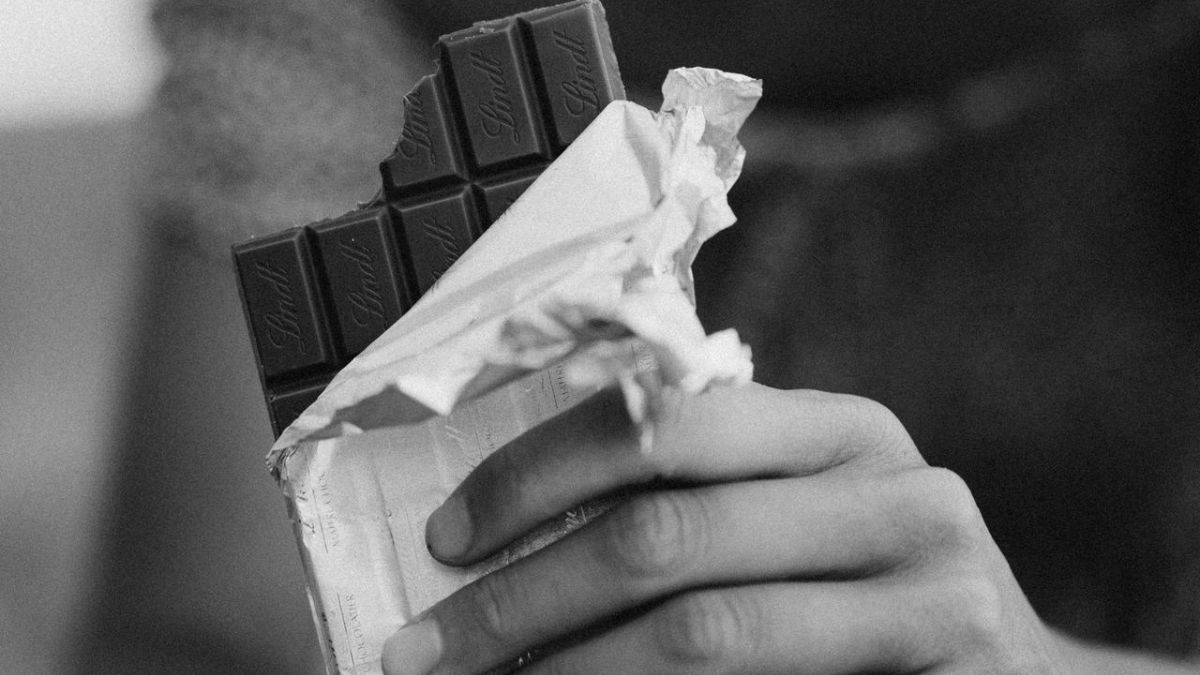
You just ate lunch. A full, proper lunch. And forty-five minutes later you are staring at a chocolate bar wondering why. Your gut has the answer, and it is not “you have no self-control.”
You just ate lunch. A full, proper lunch. And forty-five minutes later you are staring at a chocolate bar wondering why. Your gut has the answer, and it is not “you have no self-control.”
Let’s reconstruct the scene. It is somewhere between 2 and 3pm. You had lunch — rice, or rotis, or both, maybe some dal, maybe a sabzi. You ate until you were full. You went back to your desk. And now something has pulled your hand toward the office snack drawer or the chocolate someone left in the kitchen and you are not even sure when the craving arrived, just that it is here and it is specific and it wants something sweet.
This is one of the most universal human experiences and also one of the most misunderstood. Most people interpret it as a failure of willpower. The actual explanation is considerably more interesting, and considerably less about character.
What lunch just did to your blood sugar
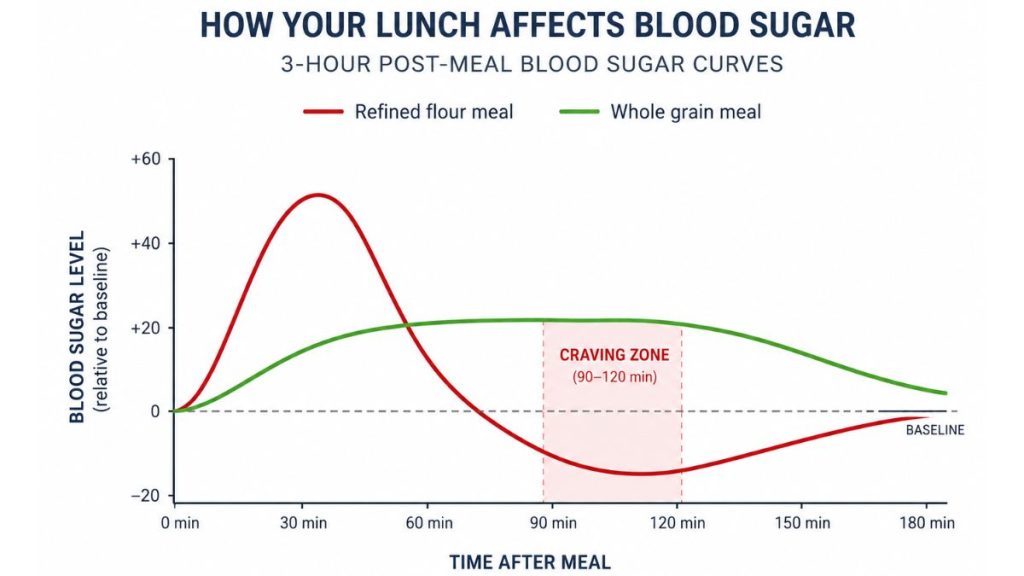
When you eat a meal that is heavy in refined carbohydrates — white rice, rotis made with refined flour, white bread, anything where the grain has been processed down to mostly starch — your body breaks it down quickly. Blood sugar rises. Your pancreas releases insulin to bring it back down. Blood sugar falls. Sometimes, if the rise was large and fast, it falls below where it started. And that drop — that specific post-meal dip — is what your brain is interpreting as “I need something sweet, I need it now, and I need it to be that specific chocolate.”
The drop is not dramatic in most people — you are not in any kind of crisis. But it is enough to trigger a hunger signal, a mild shift in mood, sometimes a fog that passes for afternoon laziness when it is actually your body signalling that it needs a top-up. And when the brain wants quick energy, it is very specific in its request. It does not ask for a bowl of dal. It asks for sugar, because sugar is the fastest route back to functional.
Your gut is not failing you. Your lunch is not sustaining you the way a lunch should. There is a difference, and the difference is entirely in what the lunch was made of.
The meal that holds vs the meal that does not
A lunch built around refined carbohydrates digests fast. A lunch built around whole grains, protein, and fibre digests slowly. The difference in how you feel two hours later is not subtle.
Whole grain flour — the stone-ground kind, where the bran and germ of the grain are intact rather than milled away — takes longer to break down than refined flour. The fibre in the bran physically slows the process. Blood sugar rises more gently. The fall is more gradual. Two hours later, you are not in the dip that triggers the craving. You are just… not particularly hungry yet.
This is why a Khapli roti — made from Aashirvaad Chakki 100% Khapli Atta, stone-ground from ancient Emmer wheat and retaining the whole grain’s structure — produces a noticeably different afternoon than a refined flour roti of the same size. It is not a miracle. It is just the grain taking longer to break down, which is exactly what you need from a lunch that has to last until dinner.
Is Khapli atta better than regular atta? Khapli is an ancient wheat variety — Emmer wheat, cultivated in India for centuries — with roughly 30% more protein than modern wheat varieties. On dietary fibre, Khapli and good whole wheat atta are closely matched at around 11g per 100g. The meaningful comparison is always whole grain versus refined flour, where the fibre gap is nearly fourfold.
But also: the chocolate craving is sometimes just the chocolate craving
Here is the nuance that any honest gut health piece has to acknowledge. Sometimes the 3pm chocolate reach is not a blood sugar response. Sometimes it is habit — you have been doing this at 3pm for three years and the body now expects it at 3pm regardless of what was for lunch. Sometimes it is stress. Sometimes it is boredom. Sometimes you genuinely just want the chocolate and that is a completely reasonable thing to want.
The distinction is worth knowing. A craving that appears regardless of what you ate, at the same time every day, is probably habit or stress or both. A craving that appears specifically when lunch was light or refined, at a variable time that tracks roughly two hours post-meal, is the blood sugar story.
The first one is addressed by noticing the habit and deciding whether it is serving you. The second one is addressed by building a better lunch.
What a better lunch actually looks like
The formula is not complicated: something with protein, something with fibre, something with a grain that is doing more than just filling space. Dal that is actually present in a meaningful quantity, not a token spoonful. A sabzi with vegetables that have some texture and substance. Rotis made with a whole grain flour rather than a refined one.
The roti is worth thinking about specifically, because most Indian lunches are built around it and that means the flour carries a lot of weight. Aashirvaad Chakki 100% Khapli Atta brings around 11g of dietary fibre per 100g — so three rotis at a typical size contribute roughly 10g of fibre to your lunch, before you have touched the dal or the sabzi. That is not a dramatic health claim. It is just a straightforward argument for why the afternoon feels different when the flour is doing its job.
That lunch — eaten without a screen, given twenty minutes of actual attention — produces an afternoon that does not require rescue. The chocolate is still there if you want it. But you will not need it in the same way.
The post-lunch craving is not a character flaw. It is a lunch composition problem. And lunch composition problems have lunch composition solutions.
Your gut wishes you knew this before you reached for the chocolate. Not because the chocolate is the enemy. But because understanding why the craving is there gives you the choice of addressing it at the source — which is considerably more satisfying than just muscling through it every afternoon.
This article is part of the What Your Gut Wishes You Knew Before… series on Happy Tummy. For general informational purposes only — not medical or dietary advice. Read more of the series here:
You are now being directed to an external website https://www.callr.live/aashirvaadexperts/premium-plan.
This link is provided for your information and convenience only and ITC Limited is not
responsible for the contents or services provided by Brand Touch India or any information that
you share with Brand Touch India.