What Your Gut Wishes You Knew Before Eating Lunch at Your Desk
The laptop is open. The call ended two minutes ago. You are eating your lunch with one eye on your inbox and zero percent of your attention on the food. Your gut is watching all of this and it has questions.
The laptop is open. The call ended two minutes ago. You are eating your lunch with one eye on your inbox and zero percent of your attention on the food. Your gut is watching all of this and it has questions.
Be honest. When was the last time you ate lunch with no screen, no phone, no background noise, and actual attention on the food? Not in a mindfulness retreat. Just in a regular week. For most working people in India, the desk lunch is not an exception — it is the default. The food is there, the screen is there, eating happens in the gaps between tasks, and the meal is technically complete by the end of it.
The gut would like to gently suggest that what just happened was not quite a meal. Not in the sense it can use, anyway.
Digestion starts before the food arrives
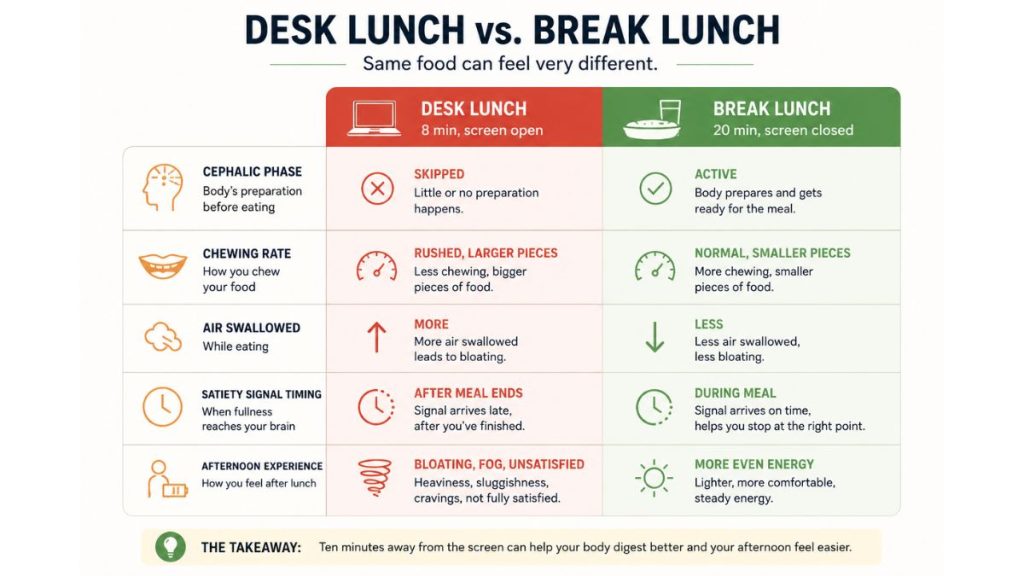
There is a preparation phase in digestion that most people have no idea exists. When you see food, smell food, or even anticipate eating, the body begins producing digestive secretions: saliva in the mouth, stomach acid, digestive enzymes. By the time the food arrives, the system is primed and ready. This is why the smell of good food makes your mouth water — your body is literally preparing to receive it.
When you eat at your desk, scrolling through emails, the preparation phase is abbreviated or absent. You are not anticipating the meal or attending to it. You are task-switching between eating and working, which means neither is getting your full attention. The digestive preparation that makes eating efficient — that means the stomach has the right amount of acid ready, the enzymes are in place — is reduced. And reduced preparation means reduced efficiency, which shows up as the post-desk-lunch bloating and heaviness that many people accept as a normal part of the working day.
It is not normal. It is the gut doing its best without the preparation it needed.
The speed problem
Desk lunches are fast lunches. You have twelve minutes between meetings, or the inbox is open, or you feel the pressure of the unfinished task sitting on the screen. The meal that would take twenty minutes to eat with attention takes eight minutes at the desk. And fast eating has consequences the gut notices even if you do not.
More air gets swallowed with rushed bites, producing bloating that has nothing to do with the food itself. Less chewing means larger pieces arriving in the stomach — more work for a system that was not fully primed to begin with, and longer digestion than the meal warranted. And then there is the satiety signal: the brain takes roughly twenty minutes to register that food has arrived. A meal eaten in eight minutes is finished well before that signal catches up, which is why the desk lunch so often leaves you vaguely unsatisfied even when you objectively ate enough.
The vague dissatisfaction after a desk lunch is not a calorie gap. It is a signal gap. The gut processed the food but the brain never properly registered the meal.
Does eating while distracted affect digestion? The digestive system has a preparation phase — saliva, stomach acid, and digestive enzymes — that begins when you anticipate and attend to food. Distracted eating shortens or skips this phase. Add faster chewing, more air swallowed, and a satiety signal that arrives after the plate is already empty, and the desk lunch is a different digestive event from the same meal eaten with attention.
The parasympathetic argument
The digestive system functions best in a parasympathetic state — what the nervous system calls “rest and digest.” This is the opposite of the sympathetic “fight or flight” state that low-level work stress activates. When you are eating while stressed, distracted, or rushing, the sympathetic system is mildly activated, and the digestive system is correspondingly less efficient.
Closing the laptop for ten minutes — not twenty, not a full hour, just ten minutes — while eating changes the nervous system state enough to make a real difference. The meal is processed better. The satiety signal has time to arrive. The afternoon is easier.
Ten minutes. The inbox will still be there.
The tiffin worth taking a break for
Part of what makes the desk lunch feel adequate is that it often is not, compositionally, the kind of meal that demands attention. A sad sandwich or reheated leftovers of uncertain provenance eaten at speed does not feel like it merits a proper break.
A proper tiffin meal changes this equation. A roti made with Aashirvaad Chakki 100% Khapli Atta, still soft at 1pm because the stone-ground grain retains moisture better than refined flour. A small container of dal. A vegetable. This is a meal that is worth sitting down for, worth eating with some attention, worth the ten minutes away from the screen. And because it is made from whole grain flour and proper ingredients, it is also the meal that makes the afternoon easier — fewer cravings, more even energy, less of that post-lunch fog.
Aashirvaad Chakki 100% Khapli Atta produces rotis that travel well and stay good for hours precisely because of the grain’s higher water absorption. Your tiffin is already halfway to solving the desk lunch problem. The other half is you, away from the screen, giving it the attention it deserves.
The desk lunch is not just a bad habit. It is a digestive handicap. The gut can work with it. It just cannot work with it as well as it could with ten minutes of actual attention.
Your gut wishes you knew this before you opened the laptop alongside your lunchbox. Not to make you feel guilty about the last hundred desk lunches. Just so that today, maybe, you close it.
This article is part of the What Your Gut Wishes You Knew Before… series on Happy Tummy. For general informational purposes only — not medical or dietary advice. Read more of the series here.
You are now being directed to an external website https://www.callr.live/aashirvaadexperts/premium-plan.
This link is provided for your information and convenience only and ITC Limited is not
responsible for the contents or services provided by Brand Touch India or any information that
you share with Brand Touch India.