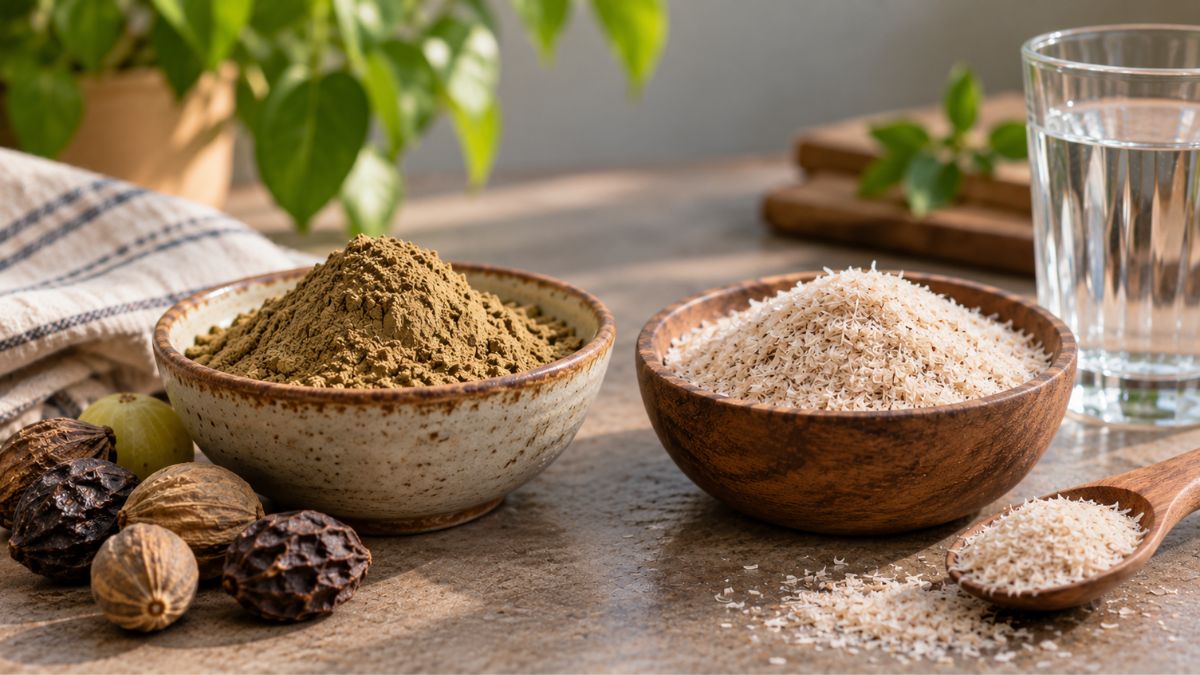
Triphala and Isabgol are both used for digestive concerns, but their evidence and safety profiles differ. Compare their uses, research, precautions and the symptoms they may suit.
Expert reviewed by Qurath Ain, Certified Nutritionist and Clinical Dietitian
Triphala churna and Isabgol are both used for constipation, but they are not equivalent remedies. Isabgol, or psyllium husk, is a bulk-forming fibre with clinical evidence for constipation. Triphala churna is a traditional three-fruit Ayurvedic formulation; human evidence for digestive benefits is limited, so claims that it ‘detoxes’, resets digestion or improves the microbiome go beyond what is established. For an occasional hard stool, a pharmacist can help you choose and use psyllium safely. Recurrent constipation, severe or persistent pain, blood in the stool or unexplained weight loss needs medical assessment rather than a remedy experiment.
The honest answer is therefore not ‘traditional versus modern’. It is ingredient, evidence, symptom and safety. A kitchen practice can be meaningful without being a proven treatment, and a familiar fibre product still needs water, label directions and the right medical context.
Triphala churna and Isabgol: what exactly are they?
Triphala churna is a multi-herb formulation
Triphala churna is a traditional Ayurvedic powder made from three fruits: amalaki or amla, bibhitaki and haritaki. The word ‘triphala’ describes the three-fruit formulation; it does not guarantee that every commercial product has the same composition, strength or quality.
Ayurvedic practitioners may use Triphala within an individualised assessment. That history is evidence of traditional use, not proof that an over-the-counter jar will treat constipation, acidity, ‘toxins’ or a named medical condition. Formulations and doses can differ, which also makes broad online instructions unreliable.
Isabgol is a bulk-forming fibre
Isabgol is the husk of Plantago ovata seeds, also called psyllium or ispaghula husk. Its soluble fibre takes up water and forms a gel-like mass, which can soften and add bulk to stool.
That mechanism is why standardised ispaghula products are used as bulk-forming laxatives. It is a narrower claim than ‘good for the gut’: psyllium may help constipation when it is appropriate and used correctly, but it does not diagnose the cause of constipation or repair every digestive problem.
What the evidence says about Isabgol benefits
Among commonly discussed fibre options, psyllium has comparatively good evidence for constipation. Current dietetic guidance also makes an important distinction: evidence for a generic instruction to ‘eat more fibre’ is not as strong as evidence for specific interventions such as psyllium in chronic constipation. Specificity matters.
A psyllium product may take a couple of days to work rather than producing an immediate bowel movement. Wind or bloating can occur, especially when fibre intake rises suddenly. If bloating is already the main problem, adding Isabgol automatically may make the picture noisier; start by identifying the symptom rather than treating the word ‘gut’.
Psyllium is sometimes discussed for loose stools because its gel can change stool consistency. That does not make self-treatment appropriate for unexplained or persistent diarrhoea. Infection, medicine effects and other causes require a different response, particularly if there is fever, blood, dehydration or marked pain. Isabgol husk should only be used under medical supervision.
What the evidence does—and does not—say about Triphala benefits
Triphala has a long place in Ayurvedic practice, but human studies for gastrointestinal problems are sparse. Much of the language online about antioxidant, antimicrobial, prebiotic or blood-sugar effects comes from laboratory or small exploratory research. Those findings can generate questions for clinical trials; they do not establish that Triphala produces the same effect in a person taking it at home.
There is not enough robust human evidence to promise that Triphala churna will ‘reset’ bowel rhythm, cleanse the colon, remove toxins or deliver broad gut-health benefits over four or eight weeks. ‘Gentle’ and ‘natural’ do not answer the central questions: what is in this product, at what dose, for whom, compared with what, and with which adverse effects?
This does not require dismissing Ayurveda. A qualified Ayurvedic physician can explain the traditional rationale and assess the individual; a gastroenterologist can investigate persistent bowel symptoms. The evidence-aware position is to keep those roles clear.
Which remedy fits which symptom?
For an occasional hard or difficult stool
A pharmacist may suggest a labelled psyllium product after checking symptoms, medicines and whether a bulk-forming laxative is suitable. Isabgol has the clearer evidence base of the two options, but that is not a recommendation for everyone and not a reason to copy a spoon measure from social media.
For recurring constipation
Recurring constipation deserves a cause-focused review. Routine, food and fluid may be relevant, but so may medicines, pregnancy, thyroid disease, pelvic-floor problems or another condition. Repeatedly rotating through powders can delay that assessment.
For gas, bloating or acidity
Neither Triphala nor Isabgol is a universal remedy for gas, bloating or acidity. Fibre can increase gas for some people, while upper-abdominal burning or reflux needs a different assessment from constipation. Record timing, portions and bowel changes before assuming one powder will solve several symptoms.
How to use Isabgol more safely
It should only be used under medical supervision, and the dosage should be age-specific. Follow the directions on the specific pack or prescription. Mix it with the stated amount of liquid, drink it promptly and maintain adequate fluid intake unless a clinician has limited your fluids. Do not swallow dry psyllium. Too little liquid can worsen constipation and raise the risk of blockage.
Ask a doctor or pharmacist before use if you have difficulty swallowing, suspected bowel narrowing or obstruction, significant abdominal pain, vomiting, a sudden change in bowel habits, or a fluid restriction. Seek urgent help for choking, breathing difficulty or inability to swallow after taking it.
Psyllium can affect the absorption of medicines and supplements. The required gap varies by product and medicine, so follow the label or a pharmacist’s instruction rather than applying one universal two-hour rule. Do not combine it with another laxative unless a doctor or pharmacist advises it. Children, pregnant people, older adults with complex illness and anyone taking regular medicines should obtain individual guidance.
Triphala safety is not just a question of dose
Triphala may cause gastrointestinal side effects, and herb–medicine interactions are possible. The three ingredients, their proportions and testing standards can vary across products. Broader safety reviews of some Ayurvedic preparations have also identified contamination with lead, mercury or arsenic; that is not proof that every Triphala product is contaminated, but it makes quality assurance a real part of the decision.
This article deliberately gives no DIY Triphala dose. Do not self-prescribe it during pregnancy or breastfeeding, for a child, alongside long-term medicines, or for a diagnosed condition. Take the exact pack and your medicine list to a qualified clinician. A certification logo or the word ‘natural’ should not substitute for ingredient, contaminant and batch-quality information.
Do not assume Triphala and Isabgol are safe to combine because they work differently or because no interaction appears in a quick search. Using two bowel-active products together can make it harder to identify the cause of cramps, diarrhoea or worsening bloating. Combination use needs a clinician or pharmacist who knows the exact products.
What about ajwain, jeera, saunf, senna and aloe?
Ajwain, jeera and saunf are familiar culinary ingredients and have traditional digestive uses. Human evidence is not strong enough to present a post-meal infusion as a treatment for persistent gas, reflux or constipation. Enjoying one as part of food is different from taking a concentrated extract.
Senna and oral aloe preparations belong in a different safety conversation. Senna is a stimulant laxative, while aloe products can contain very different parts and constituents; neither should be folded into a casual ‘natural remedies’ list. Ask a pharmacist or doctor which laxative class, if any, fits the symptom.
Food first still means matching the food to the job
If the aim is to build everyday fibre rather than treat a bowel problem, start with regular meals containing vegetables, fruit, whole grains and pulses, increasing fibre gradually and drinking enough fluid along with regular physical activity can be effective. Aashirvaad Organic Moong Dal can be one familiar pulse, along with multigrain, millets, etc in that pattern. It is not a substitute for a measured psyllium product, and it is not a constipation treatment—the value is simply in making a varied, food-first plate easier to repeat.
Try this: a three-day decision log before adding a remedy
For three days, record the symptom you want to change, stool form and frequency, straining or urgency, abdominal pain, bloating, meals, fluids and every medicine or supplement. Do not use the log to delay care if a warning sign is present. Its purpose is to replace ‘my digestion feels off’ with information a pharmacist, doctor or dietitian can use.
Your next step is one small decision: if the problem is an occasional hard stool without a warning sign, take the log and the exact product label to a pharmacist. If symptoms recur, book a medical review. Your profile hook is the main pattern—hard/infrequent stool, loose/urgent stool, bloating/gas, upper-abdominal burning, or uncertain—plus whether this is new, occasional or recurring.
When to see a doctor
Seek prompt medical attention for blood in the stool, anal fissure or piles caused due to prolong and persistent constipation, unexplained weight loss, severe or persistent abdominal pain, repeated vomiting, fever with bowel symptoms, difficulty swallowing, or possible obstruction such as marked swelling with inability to pass stool or gas. New, worsening or recurrent symptoms also need review, especially in a child, during pregnancy, later life, or with a family history of bowel disease. If constipation is affecting your daily routine and causing discomfort while performing daily simple tasks and activities, consult a doctor without any further delay.
Frequently asked questions
Is Triphala better than Isabgol?
For constipation, Isabgol has the clearer clinical evidence because it is a standardised bulk-forming fibre. Triphala is a variable traditional formulation with limited human gastrointestinal evidence. Neither is automatically suitable for every person or symptom.
Does Triphala help constipation?
Triphala is traditionally used for digestive and bowel concerns, but current human evidence is insufficient for a confident treatment recommendation or a reliable dose-and-timeline promise. Recurring constipation should be assessed rather than managed indefinitely with Triphala.
Can I take Triphala and Isabgol together?
Do not combine them on the assumption that ‘natural’ products cannot interact or add side effects. Ask a doctor or pharmacist who can review the exact formulations, your symptoms and your medicines.
Can I take Isabgol every day?
Some people use psyllium longer term under professional guidance, but daily use should be discussed with your health care professional. If constipation does not improve, worsens or keeps returning, seek medical advice instead of continually increasing the amount.
How much water should I drink with Isabgol?
Use the amount stated on the specific pack and drink it promptly; do not swallow dry psyllium. Maintain adequate fluids through the day unless a clinician has advised a restriction. If you have swallowing difficulty or a fluid limit, ask a doctor before use.
Is Triphala safe for children?
Do not give a child Triphala using an adult online dose. Children with constipation or recurrent abdominal symptoms need advice from a paediatrician; if Ayurvedic care is being considered, involve a qualified Ayurvedic physician and disclose every product to the child’s medical team.
DISCLAIMER: This is general information, not medical advice. If you’re dealing with persistent digestive symptoms, it’s worth speaking to a doctor rather than self-diagnosing from an article.