


Table of Contents
Most people think they eat enough fibre because they eat Indian food. The numbers say otherwise.
Most people think they eat enough fibre because, technically, they eat Indian food. There’s roti, sabzi, and dal sometimes. Maybe fruit on good days. Surely that counts for something.
And yet, if you calculate the average daily fibre intake in many urban Indian diets, the numbers become surprisingly underwhelming. Which explains why so many people deal with sluggish digestion, random snacking, feeling hungry too quickly, heavy post-meal fatigue, and inconsistent gut health — without realising fibre is often the main reason. Fibre deficiency rarely announces itself. It shows up as small everyday discomforts people normalise for years.
How much fibre do you actually need?
Broadly, recommended daily fibre intake for Indian adults is 40g per day per ICMR-NIN guidelines. International guidelines (AHA, NHS) suggest 25–38g depending on sex. Most urban Indian diets fall considerably short of either — somewhere in the range of 12–17g daily, sometimes lower.
The important distinction: fullness and fibre are not the same thing. You can feel full at the end of a meal and still be getting well under half of what your digestive system actually needs from that day’s food.
How much fibre does an average Indian diet provide per day?
Estimates suggest many urban Indian diets provide between 12 and 17g of dietary fibre per day, significantly below recommended levels. The shortfall is largely due to the shift from whole grains, millets, and legume-heavy cooking toward refined flour, processed snacks, and convenience foods. Switching the daily atta to a high-fibre whole grain option is one of the most direct ways to close this gap without changing what meals look like.
The hidden fibre problem in modern Indian eating
Traditional Indian diets were naturally more fibre-rich — whole grains, millets, legumes, minimally processed staples — and fibre eroded gradually as the structure of everyday food changed around people. It’s not that people stopped eating fibre. It’s that the food changed beneath them.
It’s not that people stopped eating fibre. It’s that the food changed.
What a ‘normal’ day actually looks like
Take a fairly typical urban Indian eating pattern. The fibre estimates below are approximate and pending verification — they are intended to illustrate the pattern, not to serve as precise nutritional data.
| Meal | Estimated fibre | Typical foods included |
| Breakfast | 2–4g | Toast / biscuits / poha / cornflakes + chai |
| Lunch | 4–6g | 2 rotis or rice + small sabzi + dal + salad |
| Snacks | 1–2g | Namkeen / packaged snack / bakery item + tea |
| Dinner | 4–5g | Roti/rice + curry + vegetable portion |
| Daily total (est.) | 12–17g | |
| Recommended daily intake | 40g (ICMR-NIN) |
Fibre isn’t only about digestion
Yes, fibre supports bowel regularity, gut microbiome health, and smoother digestion. But it does several other things that explain why a low-fibre diet creates a pattern of constantly eating without ever feeling genuinely sustained.
The hunger mechanism: Fibre slows the digestion of carbohydrates, which means glucose enters the bloodstream gradually rather than in a spike. When blood sugar rises sharply and then falls again — as it does after a low-fibre, refined-grain breakfast — hunger returns faster than the meal would suggest it should. The post-breakfast craving at 10:30 AM is not a willpower failure. It’s a blood sugar response to a meal that processed too quickly.
The microbiome connection: Dietary fibre is the primary food source for the beneficial bacteria living in the gut. When gut bacteria ferment fibre, they produce short-chain fatty acids — including butyrate, which nourishes the cells lining the gut wall and supports the gut’s overall integrity. A consistently low-fibre diet doesn’t just affect digestion in the short term. It gradually depletes the bacterial diversity that the gut depends on to function well.
Energy stability: A meal built around high-fibre whole grains produces a steadier metabolic curve than one built around refined flour. The practical result is the difference between a morning that holds through to lunch and one that needs rescuing with a mid-morning chai and biscuit.
Why ‘healthy snacks’ aren’t the solution
A lot of people try to add fibre through protein bars, fibre supplements, packaged cereals, or fibre biscuits. The problem with this approach is that it treats fibre as an add-on rather than a structural feature of the diet. Supplementary fixes are less reliable than getting fibre from staple foods, because staples repeat every single day, across years, without requiring any additional decision-making.
In Indian diets, the biggest staple opportunity is atta. Most households eat rotis once or twice daily, often across generations. The nutritional difference between a low-fibre refined atta and a high-fibre heritage grain atta, multiplied by that frequency, is not trivial.
This is where Aashirvaad Chakki Khapli Atta enters the conversation. Compared to refined flour, Khapli contains meaningfully higher fibre, a denser bran structure, and supports slower digestion — without changing what meals look like. The rotis are the same rotis. The grain is doing more work.
The cost-per-fibre logic is also worth considering. Khapli atta delivers approximately 11.4g of fibre per 100g of flour. At a typical usage of 30g per roti, three rotis provide approximately 10g of fibre from the flour alone — before any fibre from the accompanying sabzi or dal. A refined flour that delivers 2.76g per 100g provides approximately 2.5g from the same three rotis.
That gap, compounded daily, represents a consistent fibre shortfall that no occasional supplement can reliably bridge.
Fibre also comes from what you eat with the roti
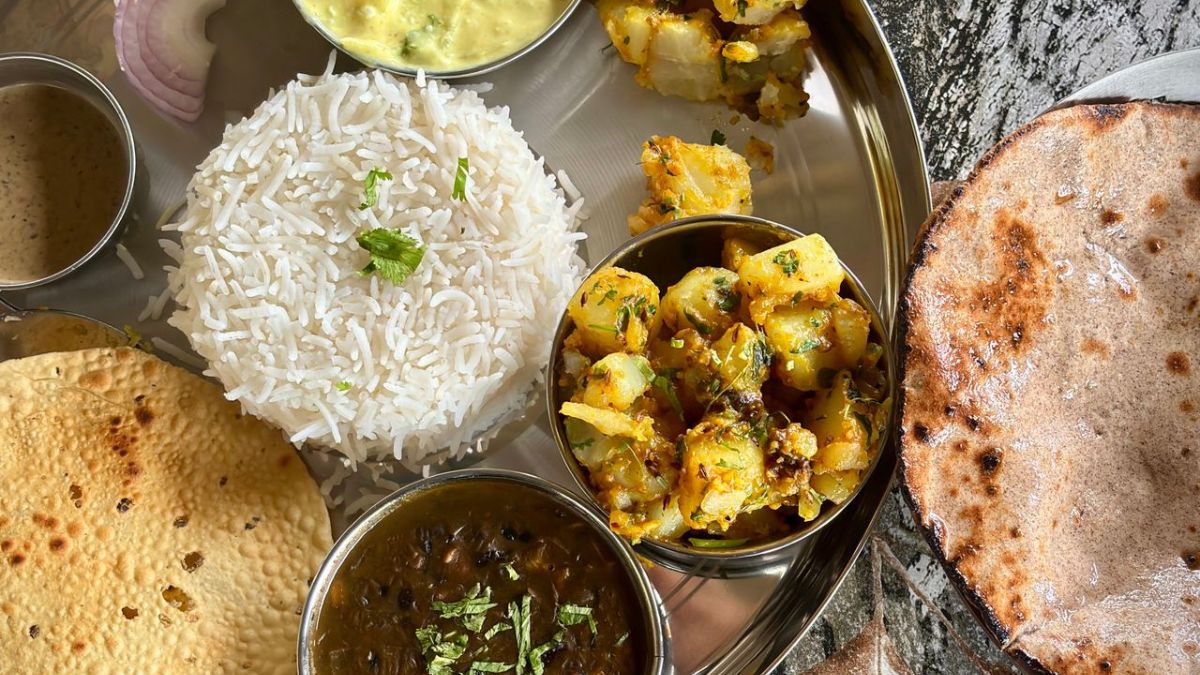
The strongest fibre-rich Indian meals combine multiple sources: whole grain rotis or rice, dal, sabzi, legumes, salads, and seasonal vegetables. Traditional Indian thalis were often naturally fibre-smart before processed convenience foods started replacing components. The goal isn’t one magic food — it’s building meals where fibre appears repeatedly and naturally from multiple sources at once.
Some surprisingly good everyday fibre sources
Beyond Khapli wheat, strong everyday fibre contributors already present in Indian kitchens include:
- Legumes: chana, rajma, and whole dals are among the richest fibre sources in the Indian diet
- Fruits: guava and amla are both excellent, and papaya and banana are good secondary sources
- Vegetables with peels: the peel of potato, ridge gourd, and similar vegetables carries most of the vegetable’s fibre — worth leaving on wherever cooking allows
- Seeds: sesame (til), flaxseed, and peanuts all contribute well
- Millets: jowar, bajra, and ragi are all higher in fibre than refined wheat
The old-school Indian snack also deserves a mention here. Roasted chana, murmura, til chikki, peanuts, and seasonal fruit — these were the default between-meal options before packaged snacks colonised the pantry. The packaged alternatives are often lower in fibre, higher in refined carbohydrate, and less sustaining. The replacement of traditional snacks with processed ones is one of the underacknowledged contributors to the urban Indian fibre gap.
Why the conversation about fibre-rich food is getting louder
Modern nutrition science keeps returning to something traditional food systems have always practised: foods that digest slowly tend to support people better long-term. The renewed interest in sourdough, ancient grains, whole grains, and fermented foods isn’t a trend that will pass. It’s a recalibration, recognising that decades of prioritising processed, fast-digesting food came with consequences that are now showing up in population health data.
Fibre-rich food isn’t fashionable. It’s genuinely important. And the simplest path to more of it, for most Indian families, is the one that was always available: choosing better grains for the daily roti.
Where Aashirvaad Chakki Khapli Atta fits in
One reason Aashirvaad Chakki Khapli Atta works as a practical fibre upgrade is that it doesn’t require reinventing meals. You still eat rotis, parathas, and everyday ghar ka khaana. The grain is less refined and more fibre-rich, which makes the upgrade easier to maintain consistently. Consistency matters more than nutritional perfection — and an atta that fits seamlessly into the existing kitchen is one that actually gets used.
The interesting thing about fibre is that most people don’t notice its absence immediately. They notice the consequences: the persistent hunger, the mid-afternoon sluggishness, the uneven digestion, the constant snacking, the post-meal crash. Fixing these things rarely requires a dramatic diet change. It usually requires slightly better everyday food, repeated consistently.
The roti is already there. The question is just what it’s made of.