
What Your Gut Wishes You Knew Before Ordering Another Late-Night Meal
It is 10 pm. You have opened the app. Your thumb is already hovering. Your gut, which has been waiting since 2 pm for a proper meal, has some thoughts about this.
Table of Contents
It is 10 pm. You have opened the app. Your thumb is already hovering. Your gut, which has been waiting since 2 pm for a proper meal, has some thoughts about this.
The late-night food delivery order is one of the most relatable experiences of modern Indian urban life. The day ran long. Dinner did not happen when it was supposed to. By 9.30 or 10 pm you are finally done with everything, genuinely hungry, completely without the energy to cook, and the app is right there. This is not a failure of planning. This is Tuesday.
The gut understands. It has been there for the whole day. It has also been waiting since that rushed lunch at 1 pm, and it would like to flag a few things before you hit order.
The digestive system runs on a circadian rhythm that is synchronised with daylight and wakefulness. Its capacity and efficiency peak in the middle of the day. By 9 or 10 pm, it is winding down in anticipation of sleep — digestive secretions reduce, gut motility slows, the system is preparing for the overnight maintenance work it does when food is not arriving.
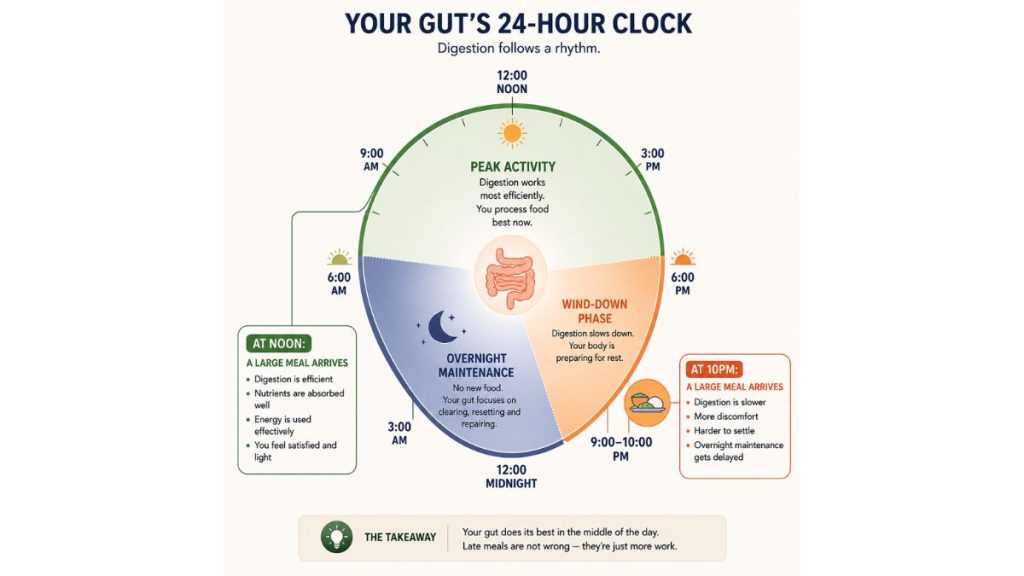
Into this winding-down system, you place a large biryani or a butter chicken with naan or a pizza. The gut responds by doing its job, because it will always do its job, but it does it more slowly, less efficiently, and with more discomfort than it would have at noon. The heavy, slightly regrettable feeling that sometimes accompanies a late large dinner is not just the food. It is the mismatch between what the digestive system was ready for and what it received.
Sleep on top of a large late meal compounds this. The gut is supposed to be doing housekeeping overnight — moving food residue through, maintaining the gut lining, running its maintenance cycle. When it is still actively digesting a large meal, the housekeeping gets delayed. Morning sluggishness, the slow start, the stomach that feels like it never quite finished with yesterday — this is the late large dinner accounting for itself.
Is eating late at night bad for digestion? The digestive system runs on a circadian rhythm, with capacity peaking around midday and winding down by evening. A large meal at 10 pm is not harmful, but it is more work — digestion slows, discomfort is more likely, and the overnight gut maintenance cycle gets delayed. Lighter, smaller, and not immediately horizontal makes a noticeable difference.
Here is the thing your gut actually wants you to know: the late-night order is often a symptom of a lunch problem, not a dinner problem. The days that end in a 10,pm food delivery are almost always the days where lunch was skipped, eaten in five minutes at a desk, or insufficient in some way. The body arrives at 9 pm with a calorie and nutrient deficit that has been accumulating since the morning, and the late-night order is the correction.
A lunch that actually held you — rotis from Aashirvaad Chakki 100% Khapli Atta with dal that earns its place on the plate rather than a token spoonful, eaten with some attention rather than at a desk with a screen — changes what happens at 10 pm. Not because it suppresses your appetite through willpower, but because the deficit is smaller. You arrive at the evening meal actually wanting dinner, not desperately, urgently hungry for anything the app can deliver in thirty minutes.
A Khapli roti with a proper dal and a sabzi at lunch — made with Aashirvaad Chakki 100% Khapli Atta, a stone-ground flour from ancient Emmer wheat — is not a wellness prescription. It is the practical reason that people who eat a sustaining lunch are less likely to be ravenous at 10 pm. The afternoon holds. The evening meal happens at a reasonable hour, in a reasonable size.
Sometimes it is going to happen anyway. The day was genuinely impossible and dinner at 10 pm from the app is the reality. Your gut’s position on this is not moralistic. It just has a few preferences for when it does happen.
Lighter is better than heavier. A dal-rice from the app is a genuinely different digestive experience than a cream-heavy curry with a lot of bread. Not because the former is virtuous, but because it is less work for a system that is already in wind-down mode. If you are ordering late, order something the gut can handle without working overtime.
Smaller is better than larger. The hunger at 10 pm feels enormous but the actual requirement, at a time when the body is preparing for sleep rather than activity, is less than it feels. A meal that is slightly smaller than your hunger suggests is almost always the right call late at night.
And then: give it some time before sleep. Not two hours, necessarily, but thirty minutes of not-horizontal is better than eating and immediately lying down.
The late-night order is not the problem. It is the solution to a problem that started much earlier in the day. Fix the earlier problem and the late-night order becomes occasional rather than routine.
Your gut has been patient about this for a long time. It would just like you to know where the story actually starts.
This article is part of the What Your Gut Wishes You Knew Before… series on Happy Tummy. For general informational purposes only — not medical or dietary advice. Read more of the series here.