What Your Gut Wishes You Knew Before Having “Just One More Cup” of Chai
The first cup is not the problem. The second cup is not really the problem either. It is the cup that is standing in for breakfast, and the cup that arrives immediately after every meal, and the cup at 11pm that you “just needed.” Your gut has been keeping track.
The first cup is not the problem. The second cup is not really the problem either. It is the cup that is standing in for breakfast, and the cup that arrives immediately after every meal, and the cup at 11pm that you “just needed.” Your gut has been keeping track.
Let us be clear from the start: this is not an anti-chai piece. Chai is one of the great pleasures of Indian life and your gut is not asking you to give it up. It is not even asking you to reduce it, necessarily. It is asking you to understand what it is doing, and when.
Because chai does different things at different times, and the difference between chai with breakfast and chai instead of breakfast is not trivial. And the difference between chai an hour after a meal and chai immediately after a meal has some genuinely interesting implications that most people have never heard anyone explain.
The empty stomach problem
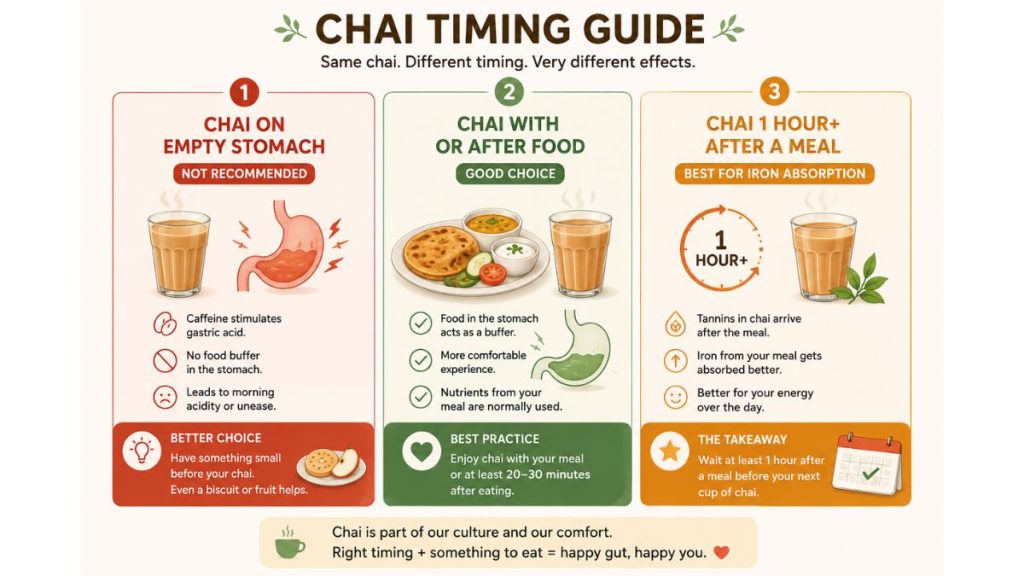
Chai on an empty stomach is one of the most common morning habits in India and one of the most reliably uncomfortable ones for the gut. Black tea contains tannins and caffeine. On an empty stomach, caffeine stimulates gastric acid production without food present to buffer it. The result, for many people, is the specific morning acidity or unsettled stomach that has become so normalised it barely registers as a symptom anymore.
It registers for the gut, though. Every morning. Consistently.
The fix is not giving up morning chai. It is having something — anything — before it. A biscuit does something. A piece of fruit does more. A small, actual breakfast does the most. Even twenty minutes of having eaten something before the chai changes what the caffeine and tannins do to the stomach lining.
This is one of the most immediately noticeable changes people describe when they shift morning chai from first thing to after-breakfast: the acidity that they had accepted as their normal state of being quietly disappears. Not because chai is gone, but because the stomach had something in it when the chai arrived.
Is chai on an empty stomach bad? For many people, yes — or at least uncomfortable. Caffeine stimulates gastric acid production, and on an empty stomach there is nothing to buffer it. The morning acidity that many regular chai drinkers accept as their normal state is often a direct result of this sequence. Having something to eat first — even a biscuit or a piece of fruit — changes the experience noticeably.
The chai-after-meals timing thing that nobody tells you
Here is the piece of information your gut most wishes you had earlier: tea consumed immediately after a meal significantly reduces the absorption of iron from that meal. The tannins in tea bind to non-haem iron — the plant-based iron from dal, leafy vegetables, whole grains — and make it harder for the gut to absorb.
For a population that relies heavily on plant-based iron sources, this is not a small thing. The dal that is one of the best everyday sources of iron in the Indian diet loses a meaningful portion of its iron benefit if it is followed immediately by chai. Iron deficiency is already one of the most prevalent nutritional deficiencies in India, particularly among women. The after-meal chai habit is a quiet, invisible contributor to this that almost nobody discusses.
The practical recommendation is simply timing: wait at least an hour after a meal before the next cup. The chai is still there. The pleasure is still there. The iron from the meal gets a chance to be absorbed before the tannins arrive.
Chai as a meal substitute
This is the version of the chai habit the gut finds most challenging. Not the three cups a day, but the specific cups that are happening because there is no time for breakfast, or because the meeting ran through lunch, or because it is 4pm and you tell yourself you are not hungry when what you actually are is busy.
Chai provides caffeine, warmth, and a small amount of milk protein. It does not provide the fibre, the sustained energy, or the macronutrient balance that an actual meal provides. When it substitutes for a meal, the gut eventually sends a signal that is hard to misread: a significant hunger that arrives later, often at an inconvenient time, and that tends to be addressed with whatever is fastest rather than whatever is best.
The meal that chai was supposed to replace does not disappear. It just arrives in a worse form, at a worse time, when you are hungrier and less thoughtful about what you choose.
What to have with the chai
The most practical version of the chai conversation is not about reducing chai. It is about making sure something accompanies it when it appears at mealtimes or between them. A cheela from Aashirvaad Chakki 100% Khapli Atta that takes ten minutes. A paratha from the previous night. A small bowl of curd and fruit. Something with actual substance that gives the gut something to work with alongside the caffeine.
This is where Aashirvaad Chakki 100% Khapli Atta earns its place — it produces quick, sustaining breakfast options that are compatible with the Indian chai habit rather than in conflict with it. A Khapli cheela with morning chai is a different gut experience from chai alone. The stomach is buffered. The energy holds. The 11am hunger that usually arrives with the urgency of a deadline does not appear on schedule.
The chai is not the problem. The chai without anything else is. Your gut loves tea. It just wishes it had something to accompany it.
Your gut is not asking you to stop. It is asking you to time it better and pair it better. The cup is still there. It is just not doing all the work by itself anymore.
This article is part of the What Your Gut Wishes You Knew Before… series on Happy Tummy. For general informational purposes only — not medical or dietary advice. Read more of the series here.
You are now being directed to an external website https://www.callr.live/aashirvaadexperts/premium-plan.
This link is provided for your information and convenience only and ITC Limited is not
responsible for the contents or services provided by Brand Touch India or any information that
you share with Brand Touch India.