What Your Gut Wishes You Knew Before Finishing Your Child’s Leftovers
The half-eaten roti. The last three spoonfuls of dal. The bits of sabzi that somehow accumulated at the corner of their plate. You were not hungry. You ate them anyway. Your gut watched the whole thing.
The half-eaten roti. The last three spoonfuls of dal. The bits of sabzi that somehow accumulated at the corner of their plate. You were not hungry. You ate them anyway. Your gut watched the whole thing.
If you are a parent, you know exactly what this is. You have cooked the meal. You have served the meal. Your child has eaten approximately sixty percent of the meal, declared themselves done, and wandered off. And now you are standing at the kitchen counter, or sitting at the table, finishing what they left. Not because you are hungry. Not because the food is particularly delicious in those last few bites. But because putting it back feels wasteful and throwing it away feels wrong and it is just there.
This happens so consistently, in so many households, that it has become invisible. It is not eating, exactly. It is clearing up. It is finishing. It is what parents do.
Your gut, which does not distinguish between “real eating” and “just finishing their plate,” counts all of it.
The invisible eating problem
One of the most consistent features of unconscious eating is that it does not register as eating. You did not sit down for a meal. You did not make a decision to eat. You did not feel hungry beforehand and you will not feel full afterward in any way you consciously notice. The calories and the inputs are real. The psychological meal experience is absent.
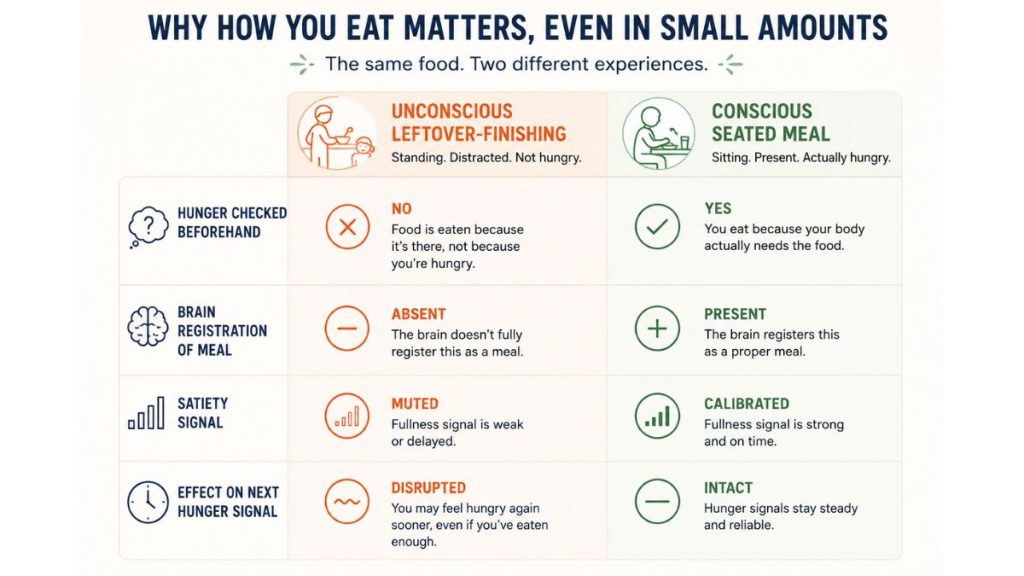
This matters because the gut’s satiety response is partly psychological. When the brain registers a meal — you sat down, you chose the food, you ate it with some attention — it calibrates the subsequent hunger signals accordingly. When the eating happens unconsciously, standing at the counter, the brain does not fully register the input. The satiety signal is muted. You are more likely to feel vaguely hungry later even though, calorically, you have eaten more than enough.
The parent who finishes their child’s leftovers and then feels genuinely hungry at dinner is not experiencing a paradox. They are experiencing the satiety gap that unconscious eating produces.
Does unconscious eating affect digestion? The gut’s satiety response is partly psychological. When the brain properly registers a meal — you chose it, sat down, ate it with attention — hunger signals calibrate accordingly. Unconscious eating, like finishing a child’s leftovers while standing at the counter, produces a muted satiety signal even when the calorie input was real. This is why you may feel vaguely hungry again within the hour, despite having technically already eaten.
The accumulated effect
The half-roti is not a catastrophe. The three spoonfuls of dal are not a problem in isolation. What accumulates is the pattern — the daily or near-daily addition of unplanned food that the gut has to process without it registering as part of a meal plan. Over time, this contributes to the general sense of always having something in the system, never being quite empty and ready for the next meal, digestion that never quite finishes before the next round begins.
It also, gently, disrupts the hunger signal. The gut learns that food arrives unpredictably, in small amounts, at odd times. The regular meal rhythm — which the gut genuinely prefers — gets blurred by the constant small additions.
The real reason it keeps happening
There is a food culture dimension to this that is worth acknowledging. In most Indian households, wasting food carries genuine emotional weight. It is not a trivial concern. The grandmother who grew up in different circumstances, the awareness of food scarcity, the specific discomfort of throwing away something that was made with care — these are real feelings and they are not wrong.
But there is a difference between “wasting food is wrong” and “I am the designated human garbage disposal for my child’s unfinished meal.” The food can be saved for later. The food can be incorporated into tomorrow’s meal. The food can be given to someone who is actually hungry. It does not have to go into your stomach at a time when your stomach was not asking for it.
Serving smaller portions and going back for more is a habit that takes less psychological effort than it sounds and produces significantly less leftover-finishing compulsion.
What the gut actually wants from you at that moment
When you are standing at the counter looking at your child’s unfinished roti, your gut’s actual position is probably one of two things. Either it is not hungry, in which case it genuinely does not want the roti regardless of what happens to it. Or it is actually hungry — in which case it would prefer that you sit down, put the food on a plate, and eat it as a proper meal.
Even a small proper meal makes a difference. A roti from Aashirvaad Chakki 100% Khapli Atta and a few spoonfuls of dal, eaten sitting down with some attention, is a different digestive event from the same food consumed standing over the counter. One registers. The other does not. The gut is not asking for elaborate. It is asking for intentional.
The distinction between eating while standing, distracted, and not technically hungry, versus eating while seated, present, and actually hungry, is a distinction the gut registers even when the brain does not.
Your gut does not have a wastage policy. It just knows whether it was actually hungry when the food arrived.
Next time the half-roti is sitting there, your gut wishes you would pause for two seconds and check in. Not as a wellness practice. Just to notice whether you are eating the roti because your body wants it, or because it is there. Either answer is fine. Just knowing the answer is the whole point.
This article is part of the What Your Gut Wishes You Knew Before… series on Happy Tummy. For general informational purposes only — not medical or dietary advice. Read more of the series here.
You are now being directed to an external website https://www.callr.live/aashirvaadexperts/premium-plan.
This link is provided for your information and convenience only and ITC Limited is not
responsible for the contents or services provided by Brand Touch India or any information that
you share with Brand Touch India.