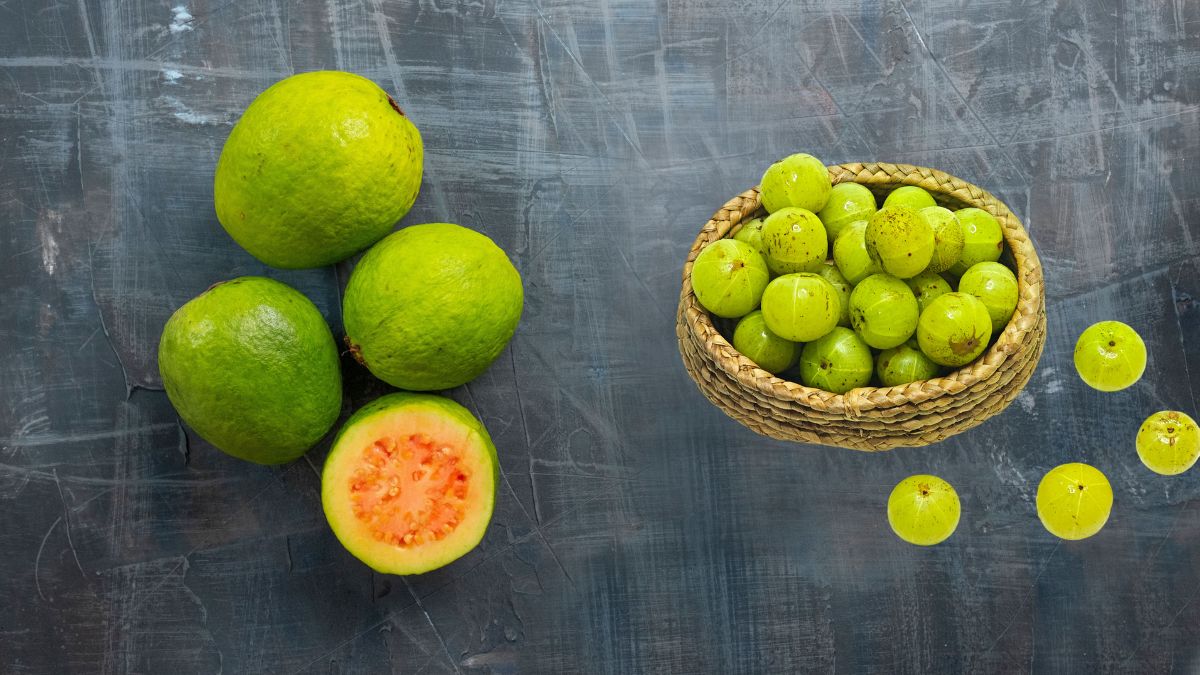
Guava and Amla: Two Indian Fruits That Quietly Do a Lot
Guava and amla are fibre-rich Indian fruits with impressive nutritional value. Here’s how their fibre, seasonality and everyday versatility make them useful additions to your diet.
Table of Contents
Guava carries about 8.59g of fibre per 100g, and amla carries about 7.75g — both IFCT 2017 figures. For context: that puts both of these everyday Indian fruits ahead of most cooked vegetables, comparable to whole pulses in their class, and significantly ahead of most other fruits. The fact that neither of them is typically discussed in the context of fibre — guava gets talked about for vitamin C; amla for immunity — is a gap this series is well-placed to close.
Guava (amrood) is genuinely one of the more fibre-dense everyday foods available in Indian markets, with about 8.59g per 100g (IFCT 2017). That’s in the same range as some whole pulses and significantly ahead of most other common fruits. Its skin contains a meaningful share of this fibre, which is why eating guava with the skin — rather than peeled — captures more of the nutritional value. Guava is also widely recognised as a good source of vitamin C, which is accurate, but it’s the fibre figure that’s most relevant to this series’ gut-health focus.
| ⓘ Guava and Amla Fibre at a Glance Guava: ~8.59g fibre per 100g (IFCT 2017) — one of the most fibre-dense common Indian fruits Amla: ~7.75g fibre per 100g (IFCT 2017) — comparable to guava; also a vitamin C standout Both available fresh, seasonally, at accessible price points in most Indian markets Eating guava with the skin retains more of the fibre content Neither needs to be eaten in large quantities — one guava or a few amlas adds meaningful fibre |
Amla (Indian gooseberry) has a cultural and medicinal reputation in India that far exceeds what most nutrition content gives it credit for. Its vitamin C content is genuinely very high — it’s one of the most vitamin-C-dense foods known, well ahead of citrus — and its fibre content at about 7.75g per 100g makes it a nutritionally interesting fruit across multiple dimensions. Amla in Ayurvedic tradition is considered a rejuvenating fruit with properties across digestion, immunity and general constitution — these claims range from well-supported (high vitamin C, fibre) to more speculative. This series addresses the verifiable ones: the fibre and vitamin C cases are genuine and don’t need the more ambiguous medicinal claims layered on top.
Both guava and amla are seasonal, which is partly why they’re not eaten year-round in most households. Guava is available roughly from October through April in North India and somewhat year-round in the South; amla is primarily a winter fruit, most abundant from October to March. Outside these seasons, dried amla, amla powder and amla candy are common forms that retain some of the nutritional value, though not identically to fresh. Dried guava and guava paste are less common but exist. The simplest, most nutritionally complete form for both remains fresh, in season, eaten with the minimum of processing.
Guava is one of the easiest fruits to add to any day’s eating — it requires no preparation beyond washing, pairs with salt and chilli in the classic street-food style, and can be eaten as a snack, alongside chai, or as a post-meal fruit. Amla in its fresh form is intensely tart and astringent, which is why most people encounter it more often in processed forms (murabba, candy, juice, powder) than fresh. A small amount of fresh amla eaten with a little jaggery, or amla juice diluted with water, are the most accessible fresh preparations for households not already cooking with it.
Guava and amla sit together naturally in this piece because they serve a similar function in the gut-health picture: both are commonly available Indian fruits with genuinely high fibre content that tends to get overshadowed by their other nutritional reputations. They’re also complementary — guava is sweeter, easier to eat regularly, and more broadly palatable; amla is more intense, more traditionally medicinal in context, and easier to incorporate via processed forms in households not comfortable with the fresh fruit’s tartness. Together they cover the most nutritionally useful end of the Indian fruit spectrum for gut health.
Indian food culture has historically included fruit in everyday eating in ways that have been somewhat eroded by urbanisation and the dominance of imported or year-round-available supermarket fruit. Guava and amla are both examples of traditional seasonal Indian fruits that deliver significant nutritional value at low cost, widely available in season, without the premium pricing of imported berries or the nutrition-marketing apparatus attached to newer ‘superfood’ fruits. Knowing their fibre figures is one way of re-credentialing fruits that were always worth eating, without needing to position them as discoveries.
The international gut-health content world frequently highlights avocado, raspberries, pears and kiwifruit for their fibre content. Guava carries about 8.59g of fibre per 100g — more than most of these. It’s available across India in season at a fraction of the cost of imported fruit, grows well in the Indian climate, and needs no elaborate preparation. The comparison isn’t to dismiss other fruits; it’s to point out that the most accessible, highest-fibre options in an Indian market are often the most local and least exotic ones. A guava from a street vendor is nutritionally competitive with the imported options this category of content usually celebrates.
Amla is the primary active ingredient in chyawanprash, one of Ayurveda’s most ancient and widely used formulations. Its role there rests primarily on its high vitamin C content and antioxidant properties, which made it valuable before modern understanding of nutrition formalised those categories. The gut-health connection to amla in traditional practice goes somewhat beyond this piece’s verified data — this series doesn’t make Ayurvedic medicinal claims, but it’s worth knowing that amla’s traditional reputation as a digestive tonic and immunity-supporting fruit isn’t without nutritional foundation, even when examined through a modern lens rather than an Ayurvedic one.
Disclaimer: This article is for general informational purposes only — not medical or dietary advice.
Yes — guava carries about 8.59g of fibre per 100g (IFCT 2017), making it one of the most fibre-dense common Indian fruits, ahead of most vegetables and comparable to some whole pulses.
Amla's fibre content (~7.75g/100g, IFCT 2017) and high vitamin C make it a genuinely nutritious fruit. Traditional digestive-benefit claims go beyond what this series verifies, but the fibre and vitamin C cases are well-supported.
Guava carries about 8.59g of fibre per 100g, which is competitive with most imported high-fibre fruits and available across India in season at a fraction of the cost.
Amla is the primary active ingredient in chyawanprash, one of Ayurveda's oldest formulations. Its traditional reputation as a digestive tonic and immunity-supportive fruit has a genuine nutritional basis in its high vitamin C and fibre content.
With the skin — the skin contains a meaningful share of the fruit's fibre content. Eating guava peeled reduces its fibre contribution.
This series doesn't give a specific daily target. Even a small amount — one or two fresh amlas, or an equivalent in processed form — adds meaningful fibre and vitamin C to a day's eating.
Yes, though dried and powdered amla has somewhat different nutritional properties from fresh. It's a practical option outside fresh amla's season and retains some of the nutritional value.
For fibre specifically, both compare very favourably with most imported fruits at a fraction of the cost. Blueberries, for instance, carry about 2.4g of fibre per 100g — well below guava or amla.