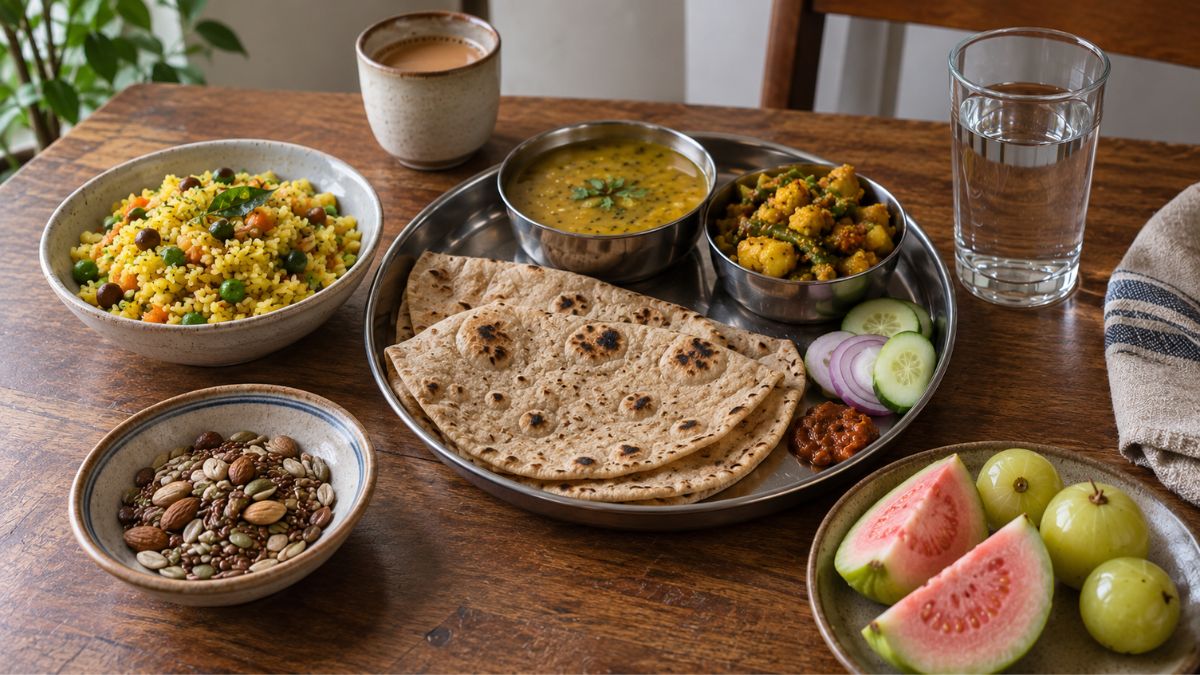
From Atta to Amla: A Full Day of High-Fibre Indian Foods
See how everyday Indian foods such as atta, dal, seeds, vegetables and fruit can add up across meals to create a fibre-varied day without relying on supplements.
Table of Contents
See how everyday Indian foods such as atta, dal, seeds, vegetables and fruit can add up across meals to create a fibre-varied day without relying on supplements.
You don’t need a fibre supplement to get close to your daily target — a fairly ordinary Indian day already has the ingredients, if they’re spread across meals rather than left to one. A roti at lunch, a katori of dal, a handful of seeds with evening chai, a guava or amla to close the day — and you’ve touched several of the most fibre-dense foods in an Indian kitchen without doing anything unusual. Here’s what that actually looks like, meal by meal.
A vegetable-loaded poha or upma, or a bowl of dalia (broken wheat), brings fibre in before the day’s properly started — broken wheat is a whole-grain option that retains more of the grain than refined flour, even without a precise figure to quote. None of these are stand-out high-fibre foods on their own, but starting the day with vegetables already on the plate sets the pattern for what follows. A plain toast-and-tea breakfast, by contrast, is a genuinely common start to the day that carries very little fibre — not a mistake, just worth knowing if it’s the everyday default rather than an occasional one.
Three rotis made from about 90g of whole wheat atta add roughly 10g of fibre. Alongside them, a regular katori of chana or moong dal is, gram for gram, more fibre-dense than the roti next to it — chana carries about 25.22g of fibre per 100g, moong about 17.04g. Add a sabzi, and the lunch thali alone is doing the bulk of a day’s fibre work, without anything on the plate needing to be unusual or specially sourced.
| ⓘ One Day’s Fibre Sources, at a Glance Morning: vegetable poha or dalia — a light, whole-grain start Midday: roti + dal + sabzi — the thali’s three combined sources Evening: a spoon of flaxseed or roasted chana — small but fibre-dense Closing: guava or amla — genuinely high-fibre fruit, not just vitamin C |
A spoon of roasted flaxseed or til, stirred into chutney or eaten with a little jaggery, is one of the most fibre-dense things on this entire list — flaxseed carries about 26.17g of fibre per 100g, sesame close behind at roughly 17g. A small bowl of roasted chana as an evening snack works the same way — small in volume, disproportionate in fibre.
Guava and amla aren’t just vitamin-C foods — both are genuinely high-fibre fruits. Guava carries about 8.59g of fibre per 100g, amla about 7.75g. Either one, eaten as a small evening or after-dinner habit, is an easy way to close out a day that’s been lighter on fibre elsewhere. Neither needs to be eaten daily to matter — even two or three times a week, swapped in for a dessert or a packaged snack, adds up over a month in a way a single high-fibre day never could on its own.
None of this requires tracking grams meal by meal. Stack a whole grain, a dal, a vegetable, a seed and a fruit across a day, and you’re touching most of the food groups ICMR-NIN recommends sourcing nutrition from — at least eight to ten a day — and comfortably working towards the ICMR fibre target of about 40g, without a single ‘hero’ ingredient doing all the work alone.
This particular sequence — poha, dal-roti thali, evening seeds, closing fruit — is one version of a fibre-varied day, not a script to follow exactly. A household that eats idli and sambar instead of poha, or rice and rasam instead of roti, can build the same variety with the same logic: a grain, a dal or lentil, a vegetable, something seed-like, something fruit-based. The specific dishes change by region and routine. The pattern — several different fibre sources across the day, rather than one food doing everything — doesn’t.
Most days have at least one snack outside the three main meals — a biscuit with tea, something from a packet, a quick bite before the next task. These don’t need to be eliminated or replaced wholesale, but they’re an easy, low-effort place to add fibre without changing a meal: a handful of roasted chana instead of a packaged snack, fruit instead of biscuits a few times a week, or simply choosing a whole-grain biscuit over a refined one where it’s available. None of these swaps needs to happen every time — even occasionally, they nudge a day’s total in a useful direction.
A day built this way works better paired with enough water — fibre depends on it to do its job properly, which is its own piece in this series (Fibre Needs Water). Adding several fibre-dense foods to a day that’s also short on fluids is a common way a genuinely good change ends up feeling uncomfortable instead.
Most fibre advice focuses on a single meal — what to eat for lunch, what to add to dinner — because it’s easier to give specific advice about one plate than about an entire day’s eating. But fibre adds up across the day, not within any one meal, which means a day that’s light at breakfast can still land well if dal, seeds and fruit show up later. This is meant as reassurance as much as guidance: a single lighter meal doesn’t undo a day’s fibre total, as long as the rest of the day picks up the slack.
Disclaimer: This article is for general informational purposes only — not medical or dietary advice.
Spread fibre-rich foods across meals rather than relying on one — a whole-grain roti at lunch, dal, a spoon of seeds in the evening, and a fibre-rich fruit like guava or amla.
Both. Amla carries about 7.75g of fibre per 100g, making it a genuinely high-fibre fruit, not only a vitamin-C one.
It varies widely, but a day with a whole-grain roti, a katori of dal, some vegetables, and a fruit or seed touches several of the most fibre-dense everyday Indian foods — without needing a specialised 'high-fibre' product.
Among commonly eaten foods, flaxseed (about 26g per 100g) and whole chana (about 25g per 100g) are near the top — both well ahead of grains like wheat atta.
Yes — idli, dosa or upma with sambar follow the same fibre-variety logic as poha or a roti thali, just with regionally different dishes carrying the grain, dal and vegetable roles.
Yes — fibre adds up across the whole day, not within a single meal, so dal, seeds and fruit later on can comfortably balance out a lighter start.