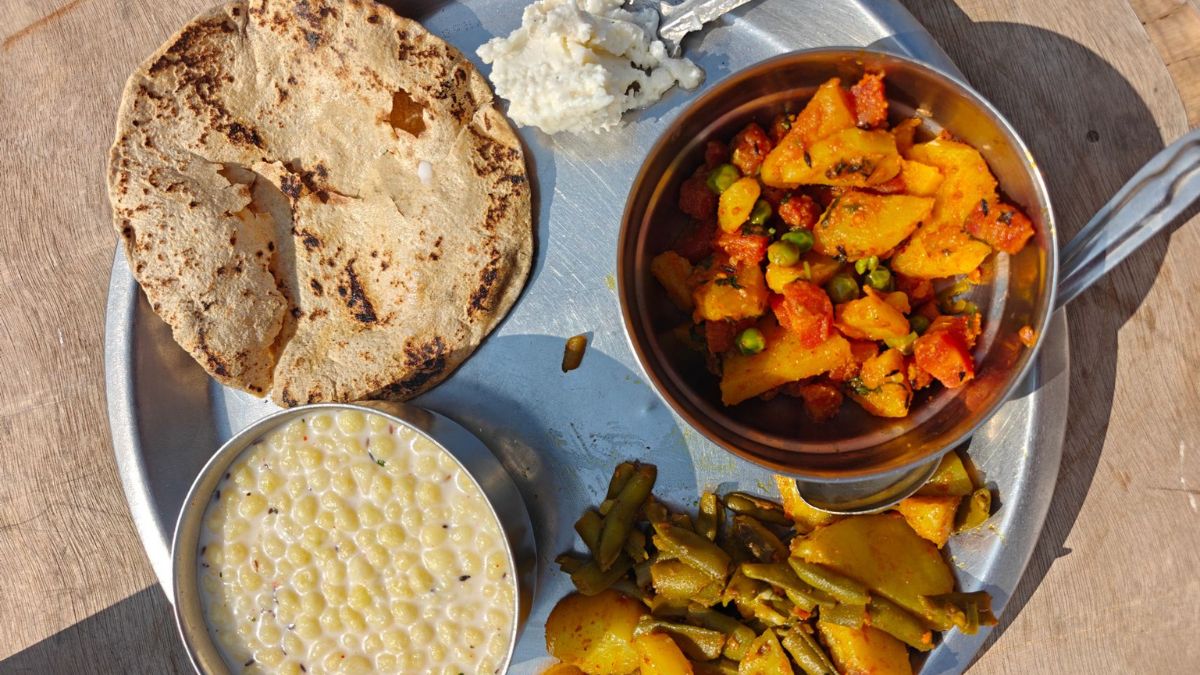
The Roti Plate Test: Is Your Meal Fibre-Friendly Enough?
A simple four-part test helps you assess whether a roti meal has enough fibre and variety, without counting every gram or overhauling your plate.
Table of Contents
A simple four-part test helps you assess whether a roti meal has enough fibre and variety, without counting every gram or overhauling your plate.
Forget grams for a moment. The fastest way to tell whether a roti meal is fibre-friendly isn’t a calculator — it’s a quick look at the plate. A genuinely fibre-friendly roti meal usually has four things on it: a whole-grain roti, a dal or pulse, a vegetable, and enough water alongside. Miss two or more of these regularly, and that’s usually where a ‘why do I feel off after eating’ question starts — not in the roti itself. Here’s how to run the test on your own plate.
One: is there a whole-grain roti on the plate — made from atta that retains the wheat bran, rather than a fully refined flour? Two: is there a dal or pulse alongside it — often more fibre-dense, gram for gram, than the roti itself? Three: is there a vegetable? ICMR-NIN recommends vegetables, fruits and tubers make up roughly half your plate, with at least 400g of vegetables and 100g of fruit a day. Four: is there water alongside the meal, or close to it — at least some progress towards a 6–8 glass daily baseline?
| ⓘ The Four-Part Test, at a Glance 1. Whole-grain roti — retains the wheat bran 2. Dal or pulse — often more fibre-dense than the roti itself 3. Vegetable — part of ICMR’s roughly half-plate recommendation 4. Water alongside the meal — supports the other three |
Each does a different job. The roti and dal both contribute fibre, but from different sources and in different amounts. The vegetable adds its own fibre plus volume and micronutrients. The water is what lets the other three actually do their job comfortably — fibre without enough fluid is a common, avoidable source of discomfort. A plate with only two or three of these isn’t a failure; it’s just one with less going for it than a plate with all four.
Two whole-wheat rotis, a katori of dal, a sabzi, and a glass of water on the side — this is, for most Indian households, an entirely ordinary lunch, not a special effort. If that’s roughly what most of your meals already look like, this test isn’t telling you anything needs to change. The point of running it isn’t to discover a problem — for many people, it confirms that the meals they’re already eating are doing the job, which is worth knowing too.
Two rotis with pickle or papad, eaten standing at the counter between tasks, no water nearby — this is also extremely ordinary, especially on a rushed day. It isn’t ‘wrong’. It’s simply a plate missing two of the four parts, which is useful to notice if it happens to be the pattern most days, not just an occasional one. The same goes for a quick breakfast of tea and biscuits, or a late dinner of just dal and rice with nothing else — each misses a different part of the test, and noticing which one is the actual point of running it.
Not every meal needs to pass this test, and trying to make every single one tick all four boxes is its own kind of unnecessary pressure. The point is noticing the pattern over a few days — which part tends to go missing, and whether that’s worth adjusting — rather than auditing any one plate in isolation.
Start with whichever part is easiest to add, not all four at once. If dal is already a daily habit but vegetables are inconsistent, that’s the gap worth closing first. If water is the part that regularly gets forgotten, a glass kept on the table during the meal does more than any other single change. Small, specific fixes — one missing part at a time — tend to stick better than trying to rebuild the whole plate in one go.
The four-part test is built around a roti meal specifically, but the underlying logic — a grain, a protein or pulse source, something vegetable- or fruit-based, and water — stretches reasonably well to other meals too. A breakfast of vegetable poha with a glass of water touches three of the four parts in spirit, even without a roti or formal dal involved. The test isn’t meant to be rigidly applied outside lunch and dinner; it’s more a way of thinking about plate-building generally.
Restaurant and delivery meals make this test slightly harder to apply cleanly, since portion sizes and what’s actually in a dish aren’t always visible. The same four questions still work as a rough guide: did the meal include a grain, a protein or pulse source, a vegetable, and was water nearby? A thali-style restaurant meal usually passes without much thought; a single dish ordered for convenience — a plain biryani, a sandwich — is more likely to be missing one or two parts, which is worth knowing rather than worrying about.
| ⓘ Common Quick Fixes by Missing Part Missing dal: a side of any pulse, even a small one, closes most of the gap Missing vegetable: a simple salad or a side sabzi, even a small portion, counts Missing water: keep a glass on the table before the meal starts, not after Missing whole grain: swap one refined-flour item for a whole-grain roti where it’s easy to do |
Calling this a ‘test’ rather than a ‘rule’ is deliberate. A rule implies every meal has to comply, which isn’t realistic and isn’t the goal. A test is something you run occasionally, out of curiosity, to see what pattern shows up — and then decide for yourself whether it’s worth acting on. Most people who run this test for a few days find their meals are already closer to passing than they expected; the value is mostly in noticing which single part, if any, tends to be the one missing.
Disclaimer: This article is for general informational purposes only — not medical or dietary advice.
A whole-grain roti, a dal or pulse, a vegetable, and enough water alongside it — four parts that, between them, cover most of what makes a meal feel comfortably filling and digestible.
Not really — dal and vegetables typically contribute meaningful fibre alongside the roti, so a meal of just roti and a condiment misses a large share of a thali's potential fibre.
No — it's a way to notice patterns over a few days, not a rule for every plate. Most regular Indian thalis already pass it without anyone trying.
The underlying logic does — a grain, a protein/pulse source, something vegetable-based, and water. A vegetable-loaded poha with water touches most of these, even without a formal roti or dal.
Ask the same four questions roughly — was there a grain, a protein or pulse, a vegetable, and water nearby? Thali-style meals usually pass easily; single convenience dishes are more likely to miss a part or two.
Identify which one part is most often missing — dal, vegetable, water or whole grain — and fix that one first, rather than trying to overhaul the whole plate at once.